Grain-Free Food and Australian Shepherds: What the FDA DCM Investigation Found
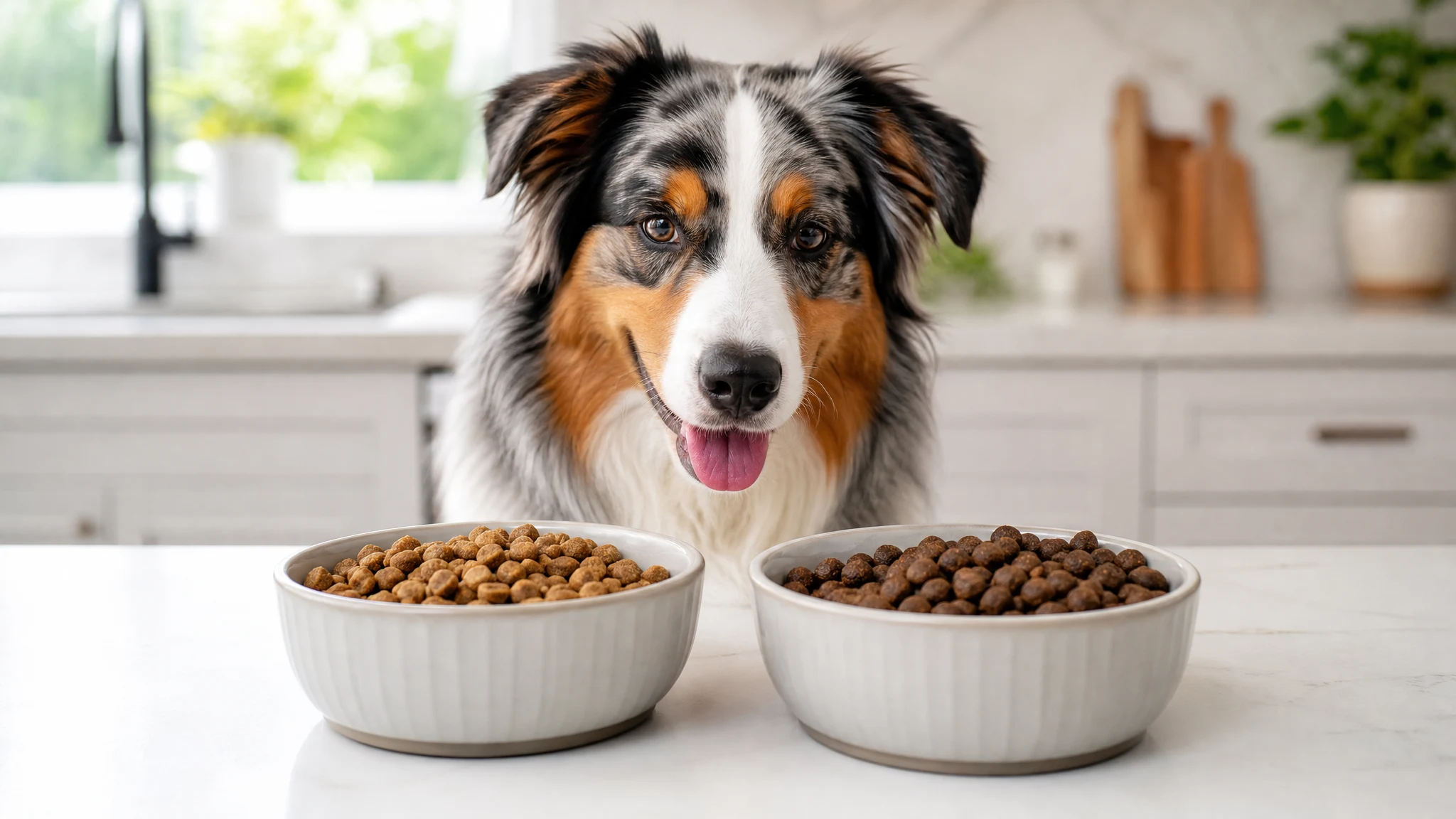
General nutrition information compiled from product labels and published sources, not veterinary advice. Your veterinarian is the right person to choose a diet for your dog, especially one with a health condition.
If you own an Australian Shepherd, you have probably seen a bag of grain free dog food and wondered whether it is a smart choice or a risk. The question comes up often because of the FDA's investigation into diets and canine dilated cardiomyopathy (DCM), a heart disease.
This guide works as a how-to. It walks you through reading the FDA's public statement, checking your own dog's food label, and preparing for a conversation with your veterinarian. It does not tell you what to feed. It shows you how to look at the question carefully and without panic.
Short answer first
The FDA's Center for Veterinary Medicine (CVM) investigated a potential link between certain diets and canine DCM. Its most recent update on the page is dated December 23, 2022. The agency says it will not post further public updates until there is meaningful new scientific information.
The FDA also does not treat the number of reports it received as proof of cause. So the honest answer to "grain free dog food DCM: is there a proven link?" is that the agency has described a potential link under investigation and has not declared a proven cause.
What you need before you start
- The bag or can your Australian Shepherd eats now, or a photo of the full label.
- The FDA's DCM investigation page (linked in the Sources list).
- Your dog's age, current weight and body condition, plus any health notes from past vet visits.
- A notepad or phone note for questions to bring to your veterinarian.
- About 30 minutes, with no need to switch foods today.
Step 1: Read what the FDA actually says
Start with the source, not a headline or a forum post. Open the FDA CVM page titled "FDA Investigation into Potential Link between Certain Diets and Canine Dilated Cardiomyopathy."
Look for three things:
- The date of the latest update. The FDA lists December 23, 2022.
- The FDA's statement that it will not issue further public updates until there is meaningful new scientific information.
- The FDA's caution about report counts. It does not call the numbers of reports proof of cause.
Write down the wording in your own notes. When a claim online sounds more certain than the FDA's own language, that gap is worth noticing.
Common mistake: treating the investigation as a finished verdict. It is described as a potential link, and the agency has not posted a conclusion that blames grain-free diets as a category.
Step 2: Separate what is known from what is not
Make two short lists. This keeps the topic from turning into fear.
What the FDA page supports
- The FDA investigated a potential diet and DCM connection.
- The latest posted update is from December 23, 2022.
- The agency will wait for meaningful new science before updating the public again.
- Report numbers are not, by the FDA's own statement, proof of cause.
What is not settled in the sources reviewed
- Whether any single ingredient, or the grain-free label itself, is the cause.
- Whether a specific brand or formula is safe or unsafe for your individual dog.
- How any of this applies to Australian Shepherds in particular.
That last point leads into the next step.
Step 3: Ask whether Australian Shepherds have a stated DCM risk
Many owners search whether grain-free is bad for Australian Shepherds specifically. The sources reviewed for this page do not give a breed-specific answer.
The health conditions tied to the breed in those sources include MDR1 drug sensitivity (described by OFA, the Orthopedic Foundation for Animals), eye conditions such as progressive retinal atrophy, Collie Eye Anomaly and juvenile cataracts (named on the Royal Canin US breed library page), and hip dysplasia, which Wikipedia reports at a relatively low prevalence of about 6 percent. None of those sources states a DCM predisposition for the breed.
That is not the same as saying the risk is zero. It means we found no breed-specific DCM statement to report. Your veterinarian, or the Australian Shepherd breed clubs, can tell you whether they know of anything more current.
Common mistake: assuming a risk that no source states, or assuming safety because none was stated. Either way, leave the question open and take it to your vet.
Step 4: Check whether your dog's food is actually grain-free
"Grain-free" is a label claim, so confirm it on your own bag. Look at the ingredient list for grains such as rice, barley, oats, wheat, corn or sorghum. If none appear, the food may be grain-free.
Note that a food can have grains and still contain peas or other legumes. Victor's Chicken Meal & Brown Rice Formula, for example, lists chicken meal, grain sorghum, peas, whole grain millet and whole grain brown rice as its first five ingredients, according to the brand's product page. It is a grain-inclusive food that also contains peas. So "grain-free" and "contains legumes" are two separate questions, and the FDA page is where to check what it says about ingredients.
Write down the following from your label:
- The first five ingredients.
- Whether the front of the bag uses the words grain-free.
- The AAFCO nutritional adequacy statement (for example, "All Life Stages" or "maintenance").
- The brand's contact information, in case your vet wants to ask the maker questions.
Step 5: Check the life stage and size wording
Grain is only one part of a label. The adequacy statement matters just as much, especially for a growing Aussie.
The Cornell University Riney Canine Health Center advises a commercial large-breed puppy diet with an AAFCO growth (or growth and lactation) adequacy statement and no extra calcium. Australian Shepherds are listed at 35 to 70 lb as adults (Wikipedia), so most stay under the 70 lb line used in label wording. A general growth or all-life-stages food is the usual match, and the large-size wording matters mainly for dogs at the top of that range.
Label wording varies. Victor's Hi-Pro Plus page states "All Life Stages, except for growth of large size dogs (70 lb. or more as an adult)." Nom Nom's page states "including growth of large size dogs (70 lb. or more as an adult)." Those are different statements, so read yours closely.
Step 6: Compare labels, not slogans
Once you understand your current food, compare it with others by the numbers on the label: ingredients, guaranteed analysis, calories per cup and the AAFCO statement. We compare label data only. We have not run feeding trials or taste tests.
Our label-by-label comparison of foods for Australian Shepherds lays out that data side by side for several brands, including dry, fresh and wet options. None of this is a recommendation for your dog, and the comparison does not say any food prevents or treats a disease.
Compare calories per cup too. Hill's Science Diet Adult Large Breed Chicken & Barley lists 365 kcal per cup, while Royal Canin Medium Adult lists 340 kcal ME per cup, per each brand's page. A cup of one food is not a cup of another, so feeding amounts on a bag are starting points, not targets.
Step 7: Prepare for the veterinarian conversation
Your veterinarian knows your dog's exam findings, history and risks. A label review cannot replace that. Bring your notes and ask questions such as:
- "Given my dog's age and health, is there a reason to change this food?"
- "Do you see anything in this ingredient list or adequacy statement that concerns you?"
- "Does my dog need any heart screening, and what would it involve?"
- "If we switch foods, how should we do it?"
- "Is there anything specific to Australian Shepherds I should know?"
Mention any medication your dog takes. Because MDR1 drug sensitivity is documented in the breed by OFA, it affects deworming and other medications, though it is not a diet issue.
Only a veterinarian can decide whether a prescription diet is appropriate. Do not choose one on your own.
Tips for a calmer, clearer process
- Keep your notes dated. The FDA page may be updated someday, so check it again occasionally.
- Do not switch foods abruptly because of an alarming post. If your vet advises a change, ask how to transition gradually.
- Save the bag's lot information until the bag is finished, so you can reference it if questions come up.
- Watch for changes in your dog and report them to your vet: unusual tiredness, coughing, trouble breathing or fainting. Do not wait for a routine visit if something seems wrong.
- Be skeptical of any food page that claims to prevent or cure heart disease. No label claim replaces a veterinary exam.
Common mistakes to avoid
- Treating "grain-free" as a verdict. The FDA page describes a potential link under investigation, not a proven cause.
- Assuming a breed risk. We found no stated DCM predisposition for Australian Shepherds in the sources reviewed. Ask your vet.
- Ignoring the adequacy statement. Life stage wording matters as much as the ingredient list.
- Adding supplements on your own. Ask your veterinarian before adding anything to your dog's diet.
- Relying on a single source. Read the FDA page itself, then talk to your vet.
What results to expect
After working through these steps, you should be able to describe what the FDA has and has not said, identify what is in your dog's food, and bring specific questions to your veterinarian. Many owners find this reduces confusion, though outcomes vary.
Reviewing a label cannot tell you whether your dog's heart is healthy, and no feeding choice can be promised to prevent any disease. A veterinarian's exam and advice remain the way to answer that for your individual dog.
If the FDA later posts new findings, the same steps apply. Read the update, note what changed, and review it with your veterinarian.
Sources
- FDA CVM: FDA Investigation into Potential Link between Certain Diets and Canine Dilated Cardiomyopathy
- Cornell University Riney Canine Health Center: Panosteitis in dogs
- OFA: Multiple Drug Sensitivity
- Royal Canin US breed library: Australian Shepherd
- Wikipedia: Australian Shepherd
- Victor: Hi-Pro Plus product page
- Victor: Chicken Meal & Brown Rice Formula product page
- Nom Nom: Chicken Cuisine product page
- Hill's Pet: Science Diet Adult Large Breed Chicken & Barley
- Royal Canin: Medium Adult Dry Dog Food