The Best Dog Food for Australian Shepherds, Compared Label by Label
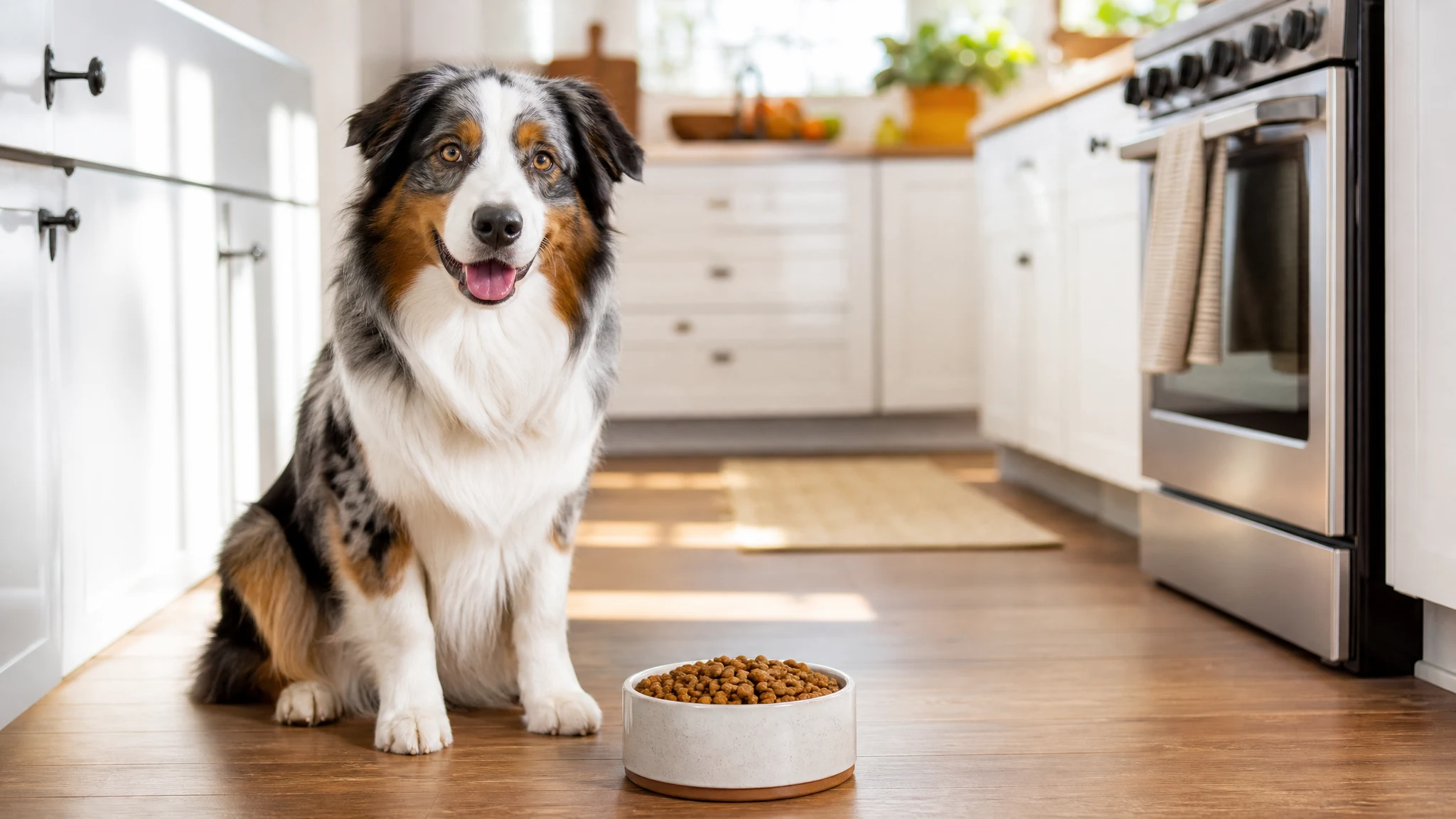
General nutrition information compiled from product labels and published sources, not veterinary advice. Your veterinarian is the right person to choose a diet for your dog, especially one with a health condition.
Every bag claims to be the best dog food for Australian Shepherds. The front of the bag is marketing. The back of the bag is where the facts are.
This guide reads the back. It compares real foods on the data their makers publish, explains what each number does and does not tell you, and sorts the foods by the situation your dog is in. It does not crown one winner, because the best food for Australian Shepherds depends on age, weight, activity and what your veterinarian says about your individual dog.
How we compared these foods
We compared label data. For each food we read the brand's own product page and noted the AAFCO statement, the life stage, protein, fat and fiber figures, calories per cup, and the first five ingredients.
We did not run feeding trials. We did not run taste tests. We did not feed these foods to dogs. Nothing here says how a particular dog will do on a particular food, and nothing here is a rating of quality beyond what the label shows.
A few limits you should know about:
- Kibble size. None of the product pages we read gave a kibble size. If size matters for your dog, check the brand before you buy.
- Prices. We list none. Prices change by store, by bag size and by week. Check the brand and your local shops.
- Hill's numbers are not the same kind of number. The Hill's pages give an average nutrient and caloric content table on a dry matter basis. Those are typical values, not label minimums or maximums.
- Royal Canin and Victor publish minimums and maximums as-fed, in a guaranteed analysis panel.
That last point matters. A Hill's typical 15 percent fat on a dry matter basis and a Royal Canin 12 percent fat minimum as-fed are not directly comparable. Treat each brand's figures as a description of that brand's own food.
What the breed tells us about food
Not much about Australian Shepherds is settled in a way that changes which bag you pick. A few points are worth knowing.
Size
Wikipedia lists the adult Australian Shepherd at 35 to 70 pounds (16 to 32 kg). The Royal Canin breed library profile, a manufacturer source, puts males at about 50 to 65 pounds and females at about 40 to 55 pounds.
That makes the breed medium-sized by weight, though no source we read states a size category outright. It matters because many foods are labeled by size. Royal Canin's Medium formulas are written for adult weights of 23 to 55 pounds. A large male Aussie can sit above that range, so read the weight range on the page and ask your veterinarian which fits.
Life stages
For the Australian Shepherd, Royal Canin's breed page describes puppy from birth to 12 months, adult from 1 to 7 years, mature from 7 to 10 years, and senior from 10 years. That is a manufacturer's framework, not a veterinary or breed club standard, so use it as a rough guide. Wikipedia cites a 2024 UK study with a median life expectancy of 13.7 years, so many Aussies spend a long time in the adult and mature stages.
Growing puppies
The Cornell University Riney Canine Health Center, in its page on panosteitis, advises a commercial large-breed puppy diet with an AAFCO growth (or growth and lactation) adequacy statement and no extra calcium. Most Aussies finish under 70 pounds, so a general growth or all-life-stages food is the usual match. The large-size wording matters mainly for puppies who will end up near the top of the 35 to 70 pound range. Your veterinarian can help you judge where your puppy is heading.
Health topics that touch food
- MDR1 drug sensitivity. The OFA describes multiple drug sensitivity in herding breeds. It is not a diet issue, but it affects medications and deworming, so tell your veterinarian and any new clinic about it.
- Hip dysplasia. Wikipedia reports a relatively low prevalence of about 6 percent. No food on this page is claimed to prevent or treat it.
- Eye conditions. The Royal Canin breed library lists progressive retinal atrophy, Collie Eye Anomaly and juvenile cataracts. Food is not a way to manage them.
We did not find a source we could open that ties Australian Shepherds to a specific diet-related condition such as obesity, bloat or food allergy. If you have worries on those fronts, that is a conversation for your veterinarian, not a reason to pick a bag.
What to look for on an Australian Shepherd food label
The AAFCO statement
This is the single most useful line on the bag. It says whether the food is formulated to meet the AAFCO Dog Food Nutrient Profiles, and for which life stage: growth, maintenance, or all life stages. It can also say the food was tested with feeding trials. Hill's pages, for example, say animal feeding tests using AAFCO procedures substantiate complete and balanced nutrition for adult maintenance. Royal Canin and Victor say their foods are formulated to meet the profiles.
A food with no statement of this kind is not a complete diet. Skip it as a main meal.
The large-size wording
Some all-life-stages foods say they cover growth except for large size dogs (70 pounds or more as an adult). Others say including growth of large size dogs. Victor Hi-Pro Plus carries the “except” wording. Nom Nom Chicken Cuisine and JustFoodForDogs Pantry Fresh carry the “including” wording.
For a typical Aussie, who stays under 70 pounds, the “except” wording is usually not a problem. For a puppy who looks headed for the heavy end of the range, ask your veterinarian before choosing.
The first five ingredients
Ingredients are listed by weight before cooking. Fresh meat is heavy with water, so it can lead the list and still contribute less protein than a meat meal further down. Meat meals are concentrated. Neither is automatically better. What the first five show is the food's main building blocks, such as rice or sorghum or chicken meal.
Read for plain, named ingredients. “Chicken by-product meal” is a named ingredient too, and the Royal Canin foods below use it. It is a legitimate feed ingredient, but you are entitled to prefer a different style of food.
Protein, fat and fiber
These come from the analysis panel. Protein and fat are minimums on most panels, so the real figure is at or above that number. Fiber is a maximum. Compare them only between foods of the same type, dry with dry and wet with wet, because water content distorts the figures.
Calories per cup
Calories are how you check portions. Two foods can look alike and differ by 80 calories a cup. In the dry foods below, the range runs from 321 to 406 kcal per cup. If you switch foods, the cup size that suited the old bag may not suit the new one.
Feeding guide
Every feeding chart is a starting point. Royal Canin says outright that its chart is only a guide and that grams are more accurate than cups. Hill's says to adjust amounts to maintain optimal weight and to ask your veterinarian if unsure. Your dog's body condition is the real measure.
Key features at a glance: the dry foods
All figures come from each brand's own product page. Royal Canin and Victor figures are label minimums (fiber is a maximum). Hill's figures are typical dry matter values.
| Food | Life stage | Protein | Fat | Fiber | kcal per cup |
|---|---|---|---|---|---|
| Royal Canin Medium Adult | Adult, medium (23 to 55 lb) | 23% min | 12% min | 3.4% max | 340 |
| Royal Canin Medium Puppy | Puppy to 12 months | 30% min | 18.4% min | 4.0% max | 410 |
| Royal Canin Medium Digestive Care | Adult, 23 to 55 lb | 23% min | 16% min | 3.7% max | 321 |
| Hill's Science Diet Adult Large Breed Chicken & Barley | Adult, large breed | 23.8% typical | 15% typical | 1.7% typical | 365 |
| Hill's Science Diet Adult Large Breed No Corn, Wheat, Soy | Adult, large breed | 23.8% typical | 16.3% typical | 1.6% typical | 390 |
| Hill's Science Diet Adult 6+ Large Breed | Adult 6+, large breed | 18.7% typical | 13.5% typical | 2.4% typical | 352 |
| Victor Hi-Pro Plus | All life stages, except large-size growth | 30% min | 20% min | 3.8% max | 406 |
| Victor Chicken Meal & Brown Rice | All life stages | 24% min | 12% min | 4.0% max | 372 |
Picks by situation
These are not rankings. They are the foods from our comparison that fit each situation on paper, with what the label shows and who each might suit.
Adult Australian Shepherds
Royal Canin Medium Adult is the closest size match we found. It is written for adults over 12 months weighing 23 to 55 pounds. Its AAFCO statement is for maintenance. The first five ingredients are brewers rice, chicken by-product meal, oat groats, wheat and corn protein meal. It lists 23 percent protein minimum, 12 percent fat minimum, and 340 kcal per cup. It suits owners who want a size-based dry food with a grain-inclusive recipe. A heavy male above 55 pounds may sit outside its stated range.
Victor Chicken Meal & Brown Rice Formula is an all-life-stages food, aimed at normal activity levels. It leads with chicken meal, grain sorghum, peas, whole grain millet and whole grain brown rice. The label shows 24 percent protein, 12 percent fat and 372 kcal per cup. It suits an Aussie with a moderate routine and an owner who wants one food that covers every stage.
Victor Hi-Pro Plus is a high-protein formula for active dogs: 30 percent protein, 20 percent fat, 406 kcal per cup, beef meal first. Aussies can be very active, but calorie-dense food is easy to overfeed. Its statement covers all life stages except growth of large size dogs, which is fine for most Aussies. If your dog is a couch-leaning pet more than a ranch worker, the lower-calorie options may suit better.
Hill's Science Diet Adult Large Breed Chicken & Barley is built for dogs with an ideal weight of 55 to 110 pounds, aged 1 to 5 years. That is above the weight of many Aussies, but it fits larger males. Chicken is the first ingredient, followed by cracked pearled barley, brown rice, brewers rice and whole grain wheat. Hill's lists 365 kcal per cup.
Hill's also makes an Adult Large Breed No Corn, Wheat, Soy recipe at 390 kcal per cup. It leads with chicken, brown rice, brewers rice, cracked pearled barley and chicken meal. It suits an owner who prefers to avoid those three ingredients, though the food is not grain-free. Note that “no corn, wheat or soy” is an ingredient choice, not a health claim.
Puppies
Royal Canin Medium Puppy is for puppies up to 12 months who will be 23 to 55 pounds as adults. It is formulated for growth under the AAFCO profiles. The first five ingredients are chicken by-product meal, chicken fat, brewers rice, corn and wheat. The label shows 30 percent protein minimum, 18.4 percent fat minimum, and 410 kcal per cup. Its feeding guide is by age in months and adult target weight.
One caution: the page we read did not show the complete AAFCO statement, so we cannot say whether it covers large-size growth. Read the full statement on the bag if your puppy may grow big.
The all-life-stages foods are another route. Victor Chicken Meal & Brown Rice covers growth with no exception. Nom Nom and JustFoodForDogs both state growth coverage including large-size dogs. Which one is right for a growing Aussie is a question for your veterinarian, especially because Cornell advises against extra calcium.
Senior and mature dogs
We found no medium-size senior formula to compare. The one older-dog food in our set is Hill's Science Diet Adult 6+ Large Breed Chicken Meal, Barley & Rice, written for dogs of 55 to 110 pounds. It leads with chicken meal, cracked pearled barley, brewers rice, whole grain wheat and whole grain corn. The typical values are 18.7 percent protein and 13.5 percent fat on a dry matter basis, and it lists 352 kcal per cup.
It is a fit on paper for a larger Aussie in the later years, but it is built for a bigger dog. Smaller Aussies and females may do better on something else. Ask your veterinarian when to move to an older-dog food, and whether to move at all.
Weight control
The only weight-focused food we compared is wet: Royal Canin Weight Care Loaf in Sauce. It is made for adult dogs of all sizes with a tendency to gain weight. The AAFCO statement is for maintenance. The 13.5 ounce can lists 263 kcal. Ingredients start with water, pork by-products, pork liver, chicken liver and chicken. The label shows 7.5 percent protein minimum and 1.1 percent fat minimum. Royal Canin says wet and dry can be fed together.
The bigger lever for most dogs is measuring portions and watching treats. Among the dry foods, Royal Canin Medium Digestive Care has the lowest calories per cup at 321, but it is marketed for digestion, not weight. Whether your Aussie needs to lose weight, and how fast, is for your veterinarian to decide.
Sensitive stomach
Royal Canin Medium Digestive Care is aimed at adults of 12 months and older, 23 to 55 pounds, with a sensitive stomach. The label shows 23 percent protein minimum, 16 percent fat minimum, 3.7 percent fiber maximum, and 321 kcal per cup. Chicken by-product meal, corn, brewers rice, chicken fat and brown rice lead the ingredients. Its feeding chart runs from 26 to 53 pounds by activity level.
This is a retail food, not a prescription diet. It does not treat a medical problem. Ongoing vomiting, loose stools or itching need a veterinarian, who may suggest an elimination trial or a prescription food. Prescription diets are something only a veterinarian prescribes.
Wet food
Wet food is mostly water, so its protein and fat percentages look small next to kibble. That does not make it weaker. The Royal Canin Weight Care loaf above is the wet food in our set. Many owners use a spoonful of wet food as a topper over dry food, which is where the calorie count per can becomes important. Count it as part of the day's total.
Fresh food
Three fresh options appear in our comparison. They have lower calories per cup than kibble because of their water content, so cup sizes are much larger.
- Freshpet Fresh From the Kitchen Home Cooked Chicken Recipe is a refrigerated adult maintenance food. Chicken, eggs, cranberries, carrots and ground oats lead. The page lists 15 percent protein minimum, 11 percent fat minimum, 1 percent fiber maximum, and 189 kcal per cup. A Freshpet nutrition sheet we came across showed a different protein figure, so check the bag in your hand.
- Nom Nom Chicken Cuisine is gently cooked, for all life stages including growth of large size dogs. Chicken, sweet potatoes, squash, spinach and dicalcium phosphate lead. The page lists 6.5 percent protein, 4.5 percent fat, 3.5 percent fiber and 244 kcal per cup.
- JustFoodForDogs Pantry Fresh Chicken & White Rice is a shelf-stable pouch, also all life stages including large-size growth. Chicken breast, chicken thighs, chicken liver, long-grain white rice and kale lead. The 12.5 ounce pack lists 6.5 percent protein, 2.5 percent fat, 1 percent fiber, and 387.5 kcal per pack (31 kcal per ounce).
Fresh foods suit owners who want recognizable ingredients and are happy to handle refrigeration or pouches. Their feeding guides run by dog weight, so follow each brand's own guide and treat it as a starting point.
Picks at different price points
We cannot sort these foods by price, because we have no verified prices and will not guess at them. Price per day depends on calories per cup, bag size, how much your dog weighs and how active they are.
What we can do is give you a way to compare cost fairly:
- Find the daily amount on the brand's feeding guide for your dog's weight.
- Divide the bag price by the number of cups in the bag.
- Multiply by your daily cups.
A calorie-dense food like Victor Hi-Pro Plus at 406 kcal per cup may need fewer cups than a 321 kcal per cup food. The cheaper bag is not always the cheaper day. Fresh foods are measured differently again, so work out cost per day, not per bag.
Red flags to avoid
- No AAFCO statement. Without one, you cannot tell if the food is complete.
- The wrong life stage. A maintenance-only food is not a growth food. A puppy needs a growth or all-life-stages statement.
- Medical promises. Any bag or ad that says a food prevents, treats or cures hip dysplasia, allergies, heart disease or bloat should lose your trust. A veterinarian decides what a dog with a medical condition eats.
- “Breed-specific” claims without detail. We found no Australian Shepherd dry formula sold in the US. A food that sounds breed-tailored should still show an AAFCO statement and a full ingredient list.
- Cup guides you never adjust. If your dog gains or loses weight on the chart amount, change the amount.
- Fear-driven marketing. On the heart-disease topic, the FDA's investigation page was last updated on December 23, 2022, and the FDA said it would not post further public updates until there is meaningful new scientific information. The FDA also does not treat report numbers as proof of cause. Be wary of anyone who claims more certainty than the FDA does. If you have questions about your dog's heart or diet, ask your veterinarian.
- Supplement stacking. Extra calcium and similar add-ons for a growing puppy go against Cornell's advice. Ask first.
Where to buy
Buy from a source you trust to store food well and rotate stock. Good options include the brand's own website, your veterinarian's clinic, and local independent or chain pet stores. We do not link to retailers, and we do not earn anything from any purchase.
Whatever the source, check the bag when it arrives:
- The AAFCO statement matches the life stage you wanted.
- The bag is sealed and undamaged, and the best-by date is well ahead.
- The recipe name matches what you looked up. Brands often have several similar names.
Switch foods slowly, mixing a little of the new food into the old over about a week or longer, unless your veterinarian says otherwise.
Questions to take to your veterinarian
- What is my dog's ideal weight, and what body condition score are they now?
- Is my puppy likely to stay under 70 pounds, and which statement should I look for?
- When should my dog move from adult to an older-dog food?
- Does my dog's activity level call for a higher-calorie formula or a lower one?
- Is there any reason, given MDR1 status or other health history, to change how I handle treats, medications or new foods?
The short version
The best food for Australian Shepherds is the one that matches your dog's life stage, keeps them at a healthy weight, and has a clear AAFCO statement. For adult Aussie food on size alone, Royal Canin Medium Adult is the closest fit we found. For larger males, Hill's large breed recipes fit better on weight. Active dogs may suit the calorie-dense Victor formulas, as long as portions are watched. Puppies need a growth or all-life-stages statement, and fresh and wet foods are valid options when you account for their calories.
Use the label to narrow the field. Use your veterinarian to make the final call.
Sources
- Wikipedia, Australian Shepherd
- Royal Canin US breed library, Australian Shepherd
- Cornell University Riney Canine Health Center, Panosteitis in dogs
- OFA, Multiple Drug Sensitivity
- FDA, Investigation into Potential Link between Certain Diets and Canine DCM
- Royal Canin, Medium Adult
- Royal Canin, Medium Puppy
- Royal Canin, Medium Digestive Care
- Royal Canin, Weight Care Loaf in Sauce
- Hill's Science Diet, Adult Large Breed Chicken & Barley
- Hill's Science Diet, Adult 6+ Large Breed
- Hill's Science Diet, Adult Large Breed No Corn, Wheat, Soy
- Victor, Hi-Pro Plus
- Victor, Chicken Meal & Brown Rice Formula
- Freshpet, Fresh From the Kitchen Home Cooked Chicken Recipe
- Nom Nom, Chicken Cuisine
- JustFoodForDogs, Pantry Fresh Chicken & White Rice Recipe