Best Training Treats for Australian Shepherds (and How Many to Give)
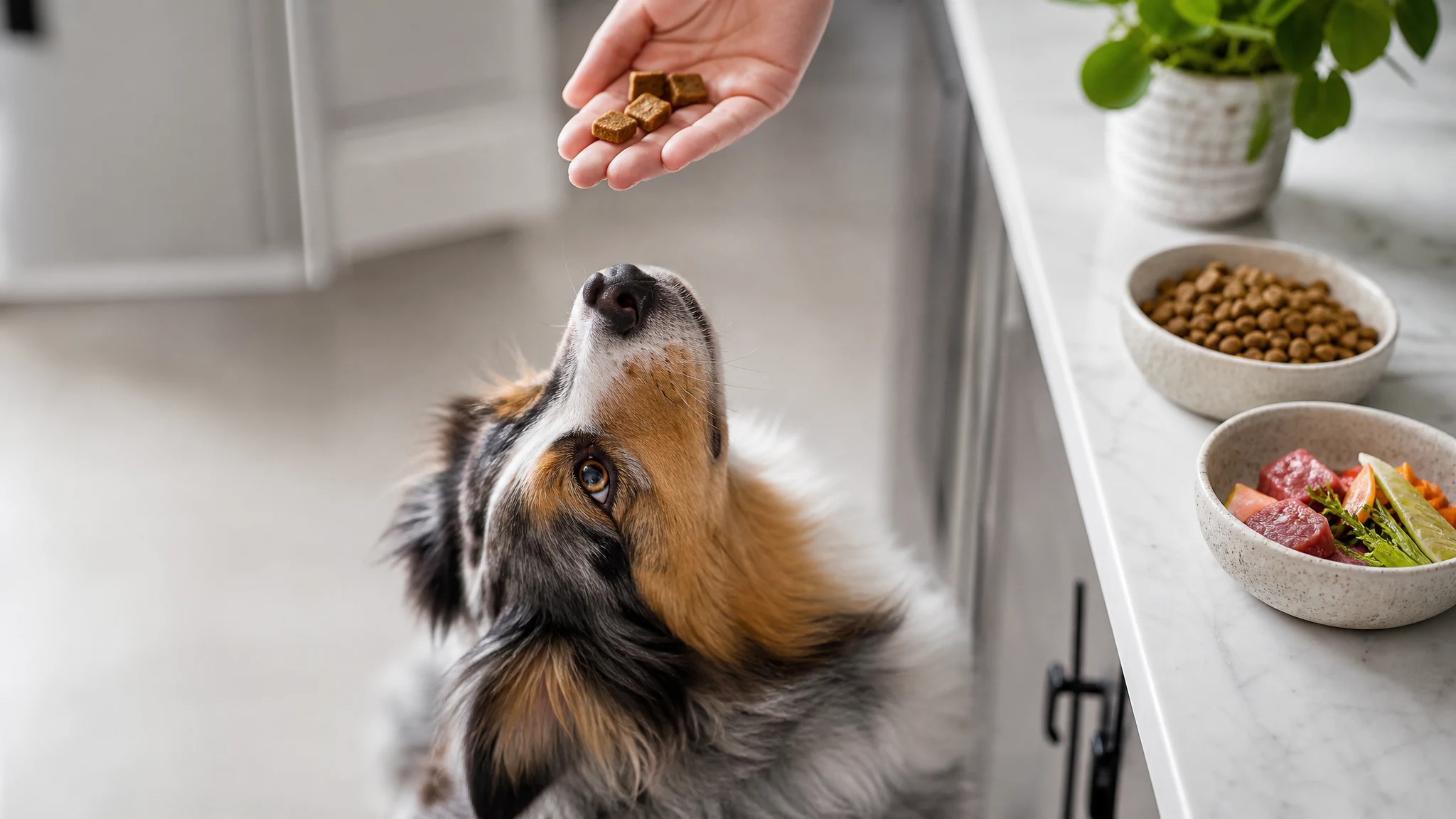
General nutrition information compiled from product labels and published sources, not veterinary advice. Your veterinarian is the right person to choose a diet for your dog, especially one with a health condition.
Australian Shepherds learn fast and work hard for a reward. That is useful in a training session. It also means treats add up quickly, because a keen dog can earn fifty rewards in a single outing.
This guide shows how to choose the best treats for Australian Shepherds, how to size them, and how to count them so training does not crowd out the regular diet. We compared label categories and general guidance. We did not run taste tests or feeding trials, so treat this as a method for reading labels, not a ranking of brands.
What You Need
- Your dog's regular food, with the calories per cup from the bag or the brand's website
- A measuring cup and a small kitchen scale if you have one
- Two or three treat types from different categories (see below)
- A treat pouch or a small container you can reach with one hand
- A small cutting board and knife for shrinking treats
- A notepad or phone note to track the day's treats
- Your veterinarian's advice on your dog's ideal weight
Why Treat Choice Matters for This Breed
Wikipedia's Australian Shepherd entry lists an adult weight of about 35 to 70 lb. That is a wide range, and a small female and a large male can have very different daily calorie needs. A treat that suits one dog may be a lot of calories for another.
Aussies are also eager and food-motivated in training, so you may use many small rewards in one session. Small, low-calorie, easy-to-swallow treats keep the pace up and keep the totals reasonable.
The Three Treat Categories Worth Knowing
Soft training treats
Soft treats are easy to bite and swallow fast, which keeps a session moving. Many can be torn into smaller pieces. Check the label for a calorie count per treat or per piece, since that figure varies a lot between products.
Freeze-dried single protein treats
These contain one meat, such as chicken or beef, with little else. They are light, strongly scented and easy to crumble into tiny pieces. A short ingredient list also makes them easier to use if your dog has a food your veterinarian wants you to avoid. They can be pricey and brittle, so they suit high-value moments such as recall practice.
Vegetables
Some dogs will work for small pieces of plain, cooked or raw vegetables, such as carrot or green bean. These are usually lower in calories than packaged treats, so they suit long sessions or dogs on a weight plan. Not every vegetable or fruit is safe for dogs, and some common foods, such as grapes, raisins and onions, are unsafe. Ask your veterinarian before adding any new food.
Step-by-Step: Choosing, Sizing and Counting Treats
Step 1: Find your dog's daily food calories
Start with the main diet. Check the calories on the bag or the brand's page. For example, Royal Canin lists its Medium Adult dry food at 340 kcal ME per cup (as fed, calculated) on its own product page. Hill's Science Diet Adult Large Breed lists 365 kcal per cup on its page. Those are examples of label data, not recommendations for your dog.
The label feeding guide is a starting point. Royal Canin's page says its guide is only a guide, and Hill's says to adjust amounts to maintain optimal weight. Your veterinarian can tell you whether your dog's body condition calls for more or less.
Step 2: Apply the 10 percent rule
WSAVA, the World Small Animal Veterinary Association, offers calorie guidance that is widely repeated: treats should make up no more than about 10 percent of a dog's daily calories. The rest should come from a complete and balanced diet.
Here is the arithmetic with a made-up number. If a dog's food plan came to 1,000 kcal a day, 10 percent would be 100 kcal for all treats combined. Your own number will differ, so use your dog's actual food plan and ask your veterinarian if you are unsure.
Step 3: Find the calories per treat
Packaged treats often list kcal per piece or per cup on the bag or the brand's site. If a treat shows only a weight, contact the brand or use a different treat. Guessing leads to overfeeding.
Fresh and cooked foods can also serve as treats, but check their labels too. Freshpet's Home Cooked Chicken Recipe, for example, lists 189 kcal per cup on its page, and Nom Nom's Chicken Cuisine lists 244 kcal per cup. They are meals, though, and not designed as treats, so using them that way means counting the calories carefully.
Step 4: Divide the budget by treat size
Divide your treat calories by the calories in each piece. That gives the number of rewards available for the day. If the number is low, make the pieces smaller or swap in a lower-calorie option.
Step 5: Cut treats to the right size
For most Australian Shepherds, a piece about the size of a pea works well. Bigger dogs near the top of the 35 to 70 lb range can handle a slightly larger piece, but smaller is usually fine. The reward is the praise and the food taste, not the chewing.
Break soft treats with your fingers or a knife. Crumble freeze-dried pieces. Cut vegetables into small cubes. Tiny pieces also reduce the chance your dog gulps and chokes.
Step 6: Match the treat to the task
Use a ladder of value. Plain vegetables or part of the kibble ration work for easy cues at home. Soft treats suit new skills and practice around mild distractions. Freeze-dried single protein pieces suit the hardest jobs, such as coming back from a squirrel or settling in a busy place.
Step 7: Reward with timing and then fade
Mark the right behavior with a word or clicker, then deliver the treat within a second or two. Reward-based training is the approach recommended by the American Veterinary Society of Animal Behavior (AVSAB). Once your dog knows a cue, reward on a mix of occasions, with praise or play in between, so the dog does not rely on food every time.
Step 8: Take treats out of the meal budget
On heavy training days, take some of the regular food and use it as rewards. Pulling a handful of kibble from the bowl is the simplest way to keep treats and meals from stacking up. If you use lots of high-calorie treats, reduce the bowl by an equivalent amount and ask your veterinarian how much.
Step 9: Track weight and adjust
Check body condition every few weeks. You should be able to feel the ribs under a light covering, and the waist should be visible from above. If your dog is gaining, cut treat calories first and talk to your veterinarian.
Reading the Label on a Treat
Check these things before you buy:
- Calories per treat or per cup. If it is missing, the product is harder to budget.
- The first ingredients. Ingredients are listed by weight, so the first few tell you most of what the treat contains.
- Treat or complete food. A treat label may say it is for intermittent or supplemental feeding only. That is a sign it is not a meal.
- Allergy or avoidance notes from your vet. A single protein list is easier to check against them.
For a broader look at the main diet, see our guide on the best dog food for Australian Shepherds compared by label. Your treat plan sits on top of that foundation.
Tips for Better Training Sessions
- Keep sessions short, about five minutes, and end while your dog is still keen.
- Pre-cut treats before you start so you are not fumbling.
- Rotate treat types so none becomes boring.
- Keep the highest-value treat for the hardest work.
- Use part of a meal as training food on busy days.
- Give people in the house the same treat budget so no one overfeeds.
Common Mistakes to Avoid
- Using large pieces. They slow the session and use up the calorie budget fast.
- Forgetting to count. Treats from visitors, chews and dental sticks all count too.
- Changing too many foods at once. If your dog gets an upset stomach, you will not know the cause. Add one new treat at a time.
- Using treats to cover for a weak routine. Food helps, but clear cues and good timing matter more.
- Assuming a treat is healthy because it sounds natural. Read the calorie figure and the ingredient list.
- Relying on treats to treat a condition. No treat prevents or treats a disease. Your veterinarian decides what suits an individual dog.
What to Expect
With small, well-timed rewards and a counted budget, many dogs stay keen to work and keep a steady weight. Results vary with the dog, the diet and the training routine, so there are no guarantees. If your dog gains weight, refuses food or has stomach upsets, pause new treats and call your veterinarian.
One more note on medication: Aussies can carry the MDR1 gene variant, which affects how some drugs are handled, according to the OFA. That is not a treat issue, but if you ever use treats to hide pills, ask your veterinarian first.
Quick Recap
- Know your dog's daily food calories.
- Keep treats to about 10 percent of daily calories, per WSAVA guidance.
- Find calories per piece.
- Cut treats to pea size.
- Match treat value to the task.
- Reduce meals on heavy training days.
- Check weight regularly and ask your veterinarian when unsure.