What Makes a Dog Food Good for an Australian Shepherd: A Label-Reading Guide
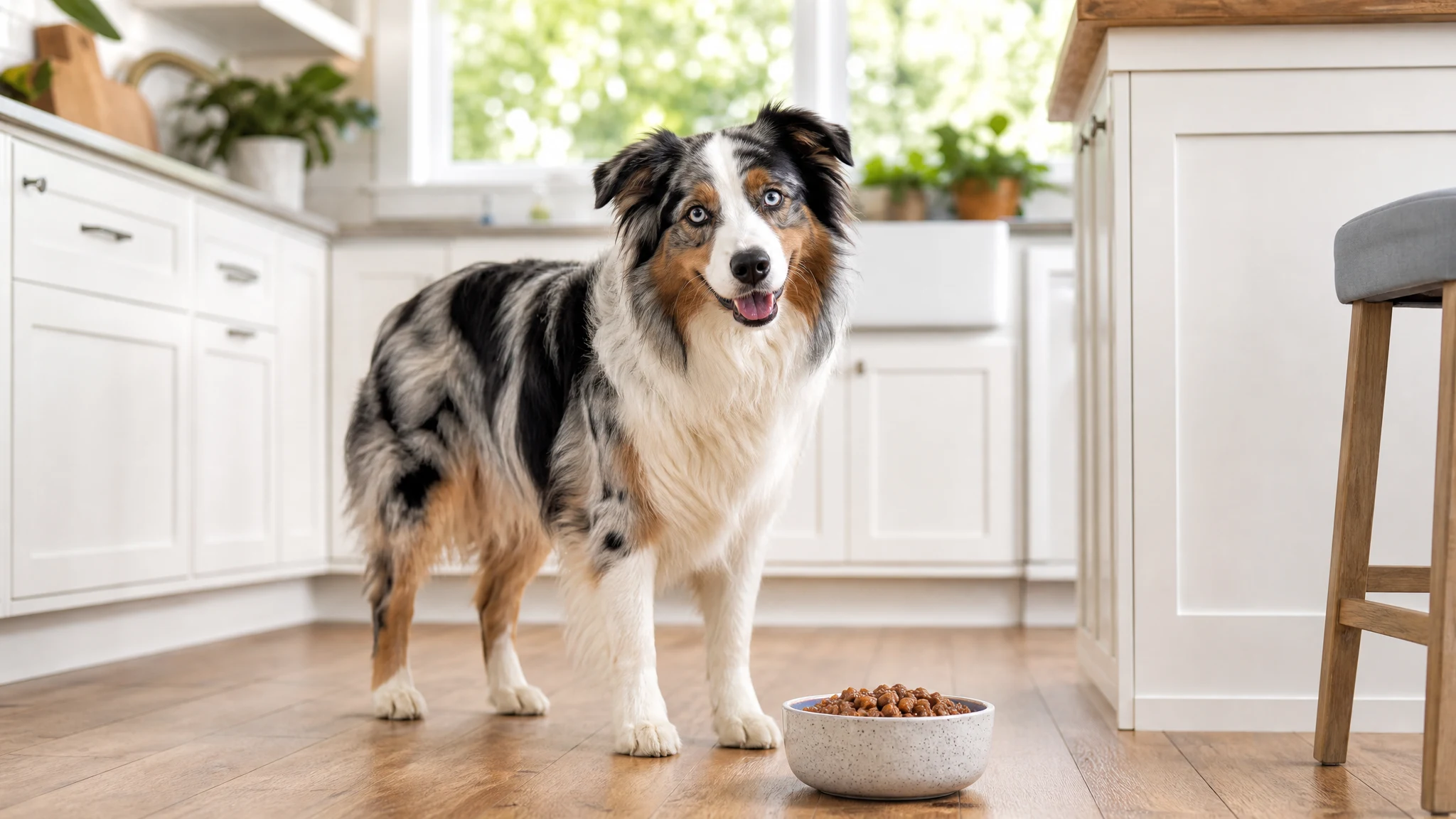
General nutrition information compiled from product labels and published sources, not veterinary advice. Your veterinarian is the right person to choose a diet for your dog, especially one with a health condition.
Choosing the best Australian Shepherd dog food is mostly a matter of reading the bag, not the marketing. Bags are full of words like "premium" and "natural" that mean little. A few label items tell you much more.
This guide shows you how to read those items, step by step, and how to apply them to an Aussie. It uses label data from brand pages. We did not run feeding trials or taste tests, so nothing here says how a dog did on any food.
What You Need Before You Start
- Your dog's age and a recent weight from your veterinarian's scale.
- The bag or the brand's product page for each food you are considering.
- A notepad or spreadsheet to line up the numbers side by side.
- Your veterinarian's input on body condition and any health concerns.
Know the Breed Basics First
According to Wikipedia, an Australian Shepherd weighs about 35 to 70 pounds as an adult. The Royal Canin breed page lists males at roughly 50 to 65 pounds and females at roughly 40 to 55 pounds. That puts most Aussies in the middle of the size range. No source we opened states an official size category, so treat "medium" as a rough description.
Royal Canin's breed page also gives life stages for the breed: puppy up to 12 months, adult from 1 to 7 years, mature from 7 to 10 years, and senior from 10 years. That is a manufacturer's view, not a veterinary or breed club ruling. Your veterinarian can tell you when your own dog should change stages.
Step 1: Find the AAFCO Statement
This is the most important line on the bag. Look for a sentence saying the food is "formulated to meet the nutritional levels established by the AAFCO Dog Food Nutrient Profiles" or that animal feeding tests substantiate complete and balanced nutrition. Without it, the food may not be complete and balanced.
Then read which life stage it names. The usual wordings are:
- Maintenance (adult): for adult dogs only, not growing puppies.
- Growth: for puppies.
- All life stages: covers puppies and adults.
Step 2: Check the Large-Size Growth Wording
Some all-life-stages labels add a phrase about large dogs. Victor Hi-Pro Plus, for example, says it is for all life stages "except for growth of large size dogs (70 lb. or more as an adult)." Nom Nom Chicken Cuisine and JustFoodForDogs Pantry Fresh say "including growth of large size dogs" instead.
Cornell University's Riney Canine Health Center advises a commercial large-breed puppy diet with an AAFCO growth adequacy statement and no extra calcium. Most Aussies finish under 70 pounds, so a general growth or all-life-stages food is the usual match. The large-size wording matters most for a puppy likely to land at the top of the range. Ask your veterinarian to estimate your puppy's adult size.
Step 3: Match the Life Stage to Your Dog
Put the food's stated stage next to your dog's age. An adult Aussie on a puppy food gets more calories and fat than an adult usually needs. A puppy on an adult-maintenance food is missing the growth statement. Royal Canin Medium Puppy, for instance, is labeled for puppies up to 12 months, while Medium Adult is for dogs over 12 months.
Step 4: Read Protein and Fat the Right Way
The guaranteed analysis lists minimum protein and fat and maximum fiber and moisture. Two cautions apply when comparing.
- Wet and fresh foods hold a lot of water, so their percentages look small. Compare them only to other wet or fresh foods, or convert to dry matter.
- Hill's pages show an average nutrient table on a dry matter basis, not a guaranteed analysis. Those are typical values, not label minimums.
A higher number is not automatically better. An active herding-type dog may do well on a richer food, and a less active one may not. Your veterinarian can judge that from your dog's body condition.
Step 5: Look at Calories Per Cup
Calories decide how much you pour. Two foods with similar protein can differ by a lot per cup, as the table shows. Use calories to compare foods, then treat the feeding chart as a starting point and adjust with your veterinarian based on your dog's body condition.
Step 6: Read the First Five Ingredients
Ingredients are listed by weight before cooking. The first five give a rough picture of the recipe. Look for a named protein source, such as chicken or chicken meal, and note the carbohydrate sources.
Do not over-read this list. "Meal" is a rendered, concentrated ingredient and is not a flaw. A "by-product meal" is not automatically bad or good. Neither the order nor a single ingredient proves a food is right or wrong for your dog.
Step 7: Compare Foods Side by Side
Here is how a few foods look when you apply the steps above. All data comes from each brand's own product page. Protein and fat are label minimums unless noted.
| Food | AAFCO life stage | Protein / Fat | Calories | First ingredients |
|---|---|---|---|---|
| Royal Canin Medium Adult (dry) | Maintenance | 23% / 12% | 340 kcal per cup | Brewers rice, chicken by-product meal, oat groats |
| Royal Canin Medium Puppy (dry) | Growth | 30% / 18.4% | 410 kcal per cup | Chicken by-product meal, chicken fat, brewers rice |
| Hill's Science Diet Adult Large Breed Chicken & Barley (dry) | Maintenance | 23.8% / 15% (typical, dry matter) | 365 kcal per cup | Chicken, cracked pearled barley, brown rice |
| Victor Hi-Pro Plus (dry) | All life stages, except growth of large dogs | 30% / 20% | 406 kcal per cup | Beef meal, grain sorghum, chicken fat |
| Victor Chicken Meal & Brown Rice (dry) | All life stages | 24% / 12% | 372 kcal per cup | Chicken meal, grain sorghum, peas |
| Nom Nom Chicken Cuisine (fresh) | All life stages, including large-size growth | 6.5% / 4.5% (high moisture) | 244 kcal per cup | Chicken, sweet potatoes, squash |
A few things stand out. Royal Canin's Medium formulas are sized for dogs with an adult weight of 23 to 55 pounds, so a large male Aussie can sit above that range. The Hill's Large Breed food is aimed at dogs of 55 to 110 pounds, which fits larger Aussies better. And Victor Hi-Pro Plus is a high-protein formula for active dogs, while Victor Chicken Meal & Brown Rice is described for normal activity levels.
None of this ranks the foods. For a longer side-by-side view, see our label comparison of foods for Australian Shepherds.
Step 8: Handle the Health Questions With Your Veterinarian
Labels cannot answer medical questions, and no food is shown here to prevent or treat any condition. A few points are worth raising at a checkup.
- MDR1 drug sensitivity. The OFA explains that this gene change affects how some drugs are handled. It is not a diet issue, but it matters for medications and dewormers.
- Heart disease and diet. The FDA's investigation into diets and dilated cardiomyopathy had its latest update on December 23, 2022. The FDA says it will not post more updates until there is meaningful new scientific information, and it does not treat report counts as proof of cause. Ask your veterinarian if you have questions about your dog's food.
- Special diets. A prescription diet is something only a veterinarian prescribes.
Step 9: Start With the Feeding Guide, Then Adjust
Use the brand's chart as a starting point. Royal Canin notes that its chart is only a guide and that grams are more accurate than cups. Hill's advises adjusting amounts to maintain optimal weight and asking your veterinarian if you are unsure.
Weigh the portion for a few days and check your dog's body condition. Change the amount in small steps with your veterinarian's guidance. When switching foods, do it gradually over several days.
Tips and Common Mistakes
- Judging by the front of the bag. Photos and slogans are not nutrition data. Read the back panel.
- Comparing wet and dry percentages directly. Water content skews the numbers.
- Feeding a puppy food long past 12 months. Check the life stage on the label.
- Adding calcium to a puppy diet. Cornell advises against extra calcium.
- Counting treats as free. They add calories on top of the bowl.
- Chasing the highest protein number. More is not automatically better for every dog.
- Switching suddenly. Abrupt changes are a common cause of upset stomachs.
What to Expect
If you match the AAFCO statement and life stage to your dog and portion carefully, you may find it easier to keep your Aussie at a steady, lean weight. Coat, energy and stool quality can vary from dog to dog and from week to week, so any change you notice is worth discussing with your veterinarian. Results differ, and a label cannot predict how an individual dog will respond.
Finding the best Australian Shepherd dog food comes down to a repeatable process. Check the statement, match the life stage, compare calories, and confirm with your veterinarian. Prices, current formulas and kibble sizes change, so check the brand's page or the bag for the latest details.
Sources
- Wikipedia, Australian Shepherd
- Royal Canin, Australian Shepherd breed library
- Cornell University Riney Canine Health Center, Panosteitis in dogs
- OFA, Multiple Drug Sensitivity
- FDA, Investigation into Potential Link between Certain Diets and Canine DCM
- Royal Canin Medium Adult and Medium Puppy
- Hill's Science Diet Adult Large Breed
- Victor Hi-Pro Plus and Chicken Meal & Brown Rice Formula
- Nom Nom Chicken Cuisine