Top Dry Dog Food Picks for Australian Shepherds, Compared by Label
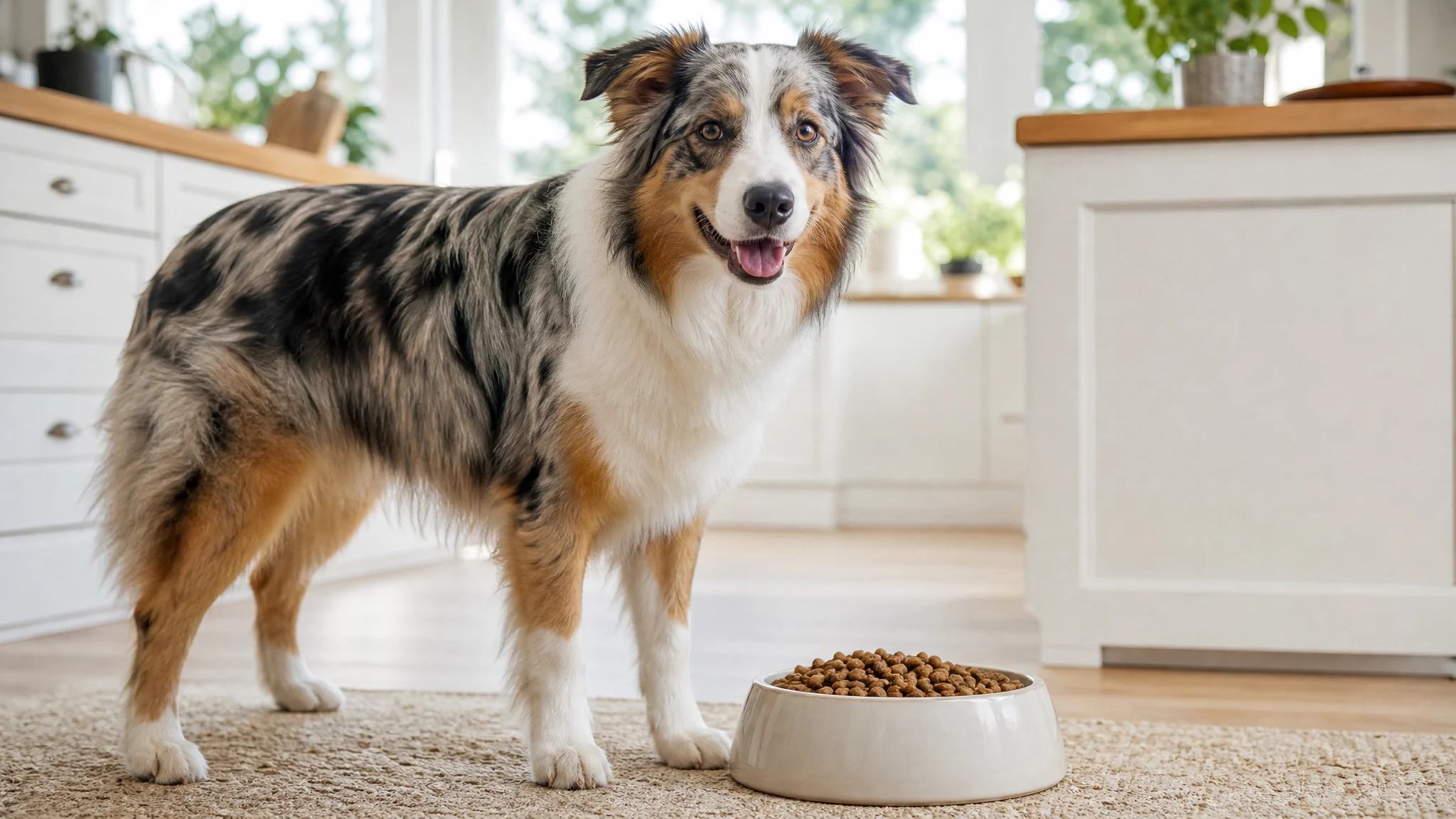
General nutrition information compiled from product labels and published sources, not veterinary advice. Your veterinarian is the right person to choose a diet for your dog, especially one with a health condition.
Lists of the "top 10 best dry dog food" are easy to find and hard to trust. Most rank by opinion or by who paid for placement. This guide takes a different approach. It shows you how to compare dry foods for an Australian Shepherd using only what is printed on the brand's own product page.
We compared label data. We did not run feeding trials or taste tests, and we do not rank the foods. Eight dry foods from three brands appear below, so this is a worked example, not a full top 10. For a wider look, see our label-based comparison of foods for Australian Shepherds.
Why the Australian Shepherd needs its own checklist
Wikipedia lists the Australian Shepherd adult weight at 35 to 70 lb (16 to 32 kg). The Royal Canin breed page gives about 50 to 65 lb for males and 40 to 55 lb for females. That makes the breed medium sized, though no source states a size category, so that is an inference from weight.
Royal Canin's breed page gives these life stages: puppy to 12 months, adult from 1 to 7 years, mature from 7 to 10 years, and senior from 10 years. That is a manufacturer's view, not a veterinary or breed club standard.
One more point. I did not find a breed-specific Australian Shepherd dry formula sold in the US. Treat any bag that claims one with the same label checks below.
Materials you need
- The product page or bag for each food you are considering
- Your dog's current weight and age
- A notebook or spreadsheet
- A kitchen scale, since Royal Canin notes that grams are the most accurate way to measure
- Your veterinarian's advice on your dog's body condition
Step-by-step: compare dry foods by label
Step 1: Match the life stage
Find the AAFCO statement. It says whether the food is for growth, adult maintenance, or all life stages. A food built for adult maintenance is not meant for a growing puppy.
Royal Canin Medium Puppy is for puppies up to 12 months. Royal Canin Medium Adult is for dogs over 12 months. The Victor foods below are labeled for all life stages.
Step 2: Read the large-size wording
Some labels say "including growth of large size dogs (70 lb. or more as an adult)." Others say "except for growth of large size dogs." Victor Hi-Pro Plus carries the "except" wording on its product page.
Cornell's Riney Canine Health Center advises a commercial large-breed puppy diet with an AAFCO growth adequacy statement and no extra calcium. Most Aussies finish under 70 lb, so a general growth or all-life-stages food is the usual match. The wording matters most for puppies likely to land at the top of the breed's weight range.
Step 3: Check the first five ingredients
Ingredients are listed by weight before cooking. The first five tell you the main building blocks. Note whether the first item is a named meat, a meal, or a grain.
A meal is a concentrated ingredient, so it is not automatically worse than fresh meat. Compare what the list shows, not what the front of the bag suggests.
Step 4: Compare protein and fat the right way
Royal Canin and Victor give guaranteed analysis minimums. Hill's pages give an average nutrient table on a dry matter basis instead. Those Hill's figures are typical values, not guaranteed minimums, so do not set them side by side with the others as if they were the same measure.
Step 5: Look at calories per cup
Calories decide how much you pour. A food at 406 kcal per cup needs a smaller scoop than one at 321 kcal per cup. Compare calories before you compare price per bag.
Step 6: Use the feeding guide as a starting point
Every brand's guide is a starting point. Hill's says to adjust amounts as necessary to maintain optimal weight and to ask your veterinarian if you are unsure. Royal Canin says its chart is only a guide.
The comparison table
All figures come from each brand's own product page. Kibble size was not listed on the pages I opened, so check the brand if size matters for your dog.
| Food | AAFCO life stage | Protein | Fat | Calories | First ingredients |
|---|---|---|---|---|---|
| Royal Canin Medium Adult | Maintenance (adult over 12 months, 23-55 lb) | 23% min | 12% min | 340 kcal ME per cup | Brewers rice, chicken by-product meal, oat groats, wheat, corn protein meal |
| Royal Canin Medium Puppy | Growth (up to 12 months) | 30% min | 18.4% min | 410 kcal ME per cup | Chicken by-product meal, chicken fat, brewers rice, corn, wheat |
| Royal Canin Medium Digestive Care | Maintenance (adult, 23-55 lb) | 23% min | 16% min | 321 kcal ME per cup | Chicken by-product meal, corn, brewers rice, chicken fat, brown rice |
| Hill's Science Diet Adult Large Breed Chicken & Barley | Maintenance (adult 1-5 years, ideal weight 55-110 lb) | 23.8% typical, dry matter | 15% typical, dry matter | 365 kcal per cup | Chicken, cracked pearled barley, brown rice, brewers rice, whole grain wheat |
| Hill's Science Diet Adult 6+ Large Breed Chicken Meal, Barley & Rice | Maintenance (adult 6+ years, 55-110 lb) | 18.7% typical, dry matter | 13.5% typical, dry matter | 352 kcal per cup | Chicken meal, cracked pearled barley, brewers rice, whole grain wheat, whole grain corn |
| Hill's Science Diet Adult Large Breed No Corn, Wheat, Soy | Maintenance (adult 1-5 years, 55-110 lb) | 23.8% typical, dry matter | 16.3% typical, dry matter | 390 kcal per cup | Chicken, brown rice, brewers rice, cracked pearled barley, chicken meal |
| Victor Hi-Pro Plus | All life stages, except growth of large size dogs | 30% min | 20% min | 406 kcal per cup | Beef meal, grain sorghum, chicken fat, whole grain millet, blood meal |
| Victor Chicken Meal & Brown Rice | All life stages | 24% min | 12% min | 372 kcal per cup | Chicken meal, grain sorghum, peas, whole grain millet, whole grain brown rice |
Brand pages: Royal Canin Medium Adult, Royal Canin Medium Puppy, Royal Canin Medium Digestive Care, Hill's Adult Large Breed, Hill's Adult 6+ Large Breed, Hill's No Corn, Wheat, Soy, Victor Hi-Pro Plus, Victor Chicken Meal & Brown Rice.
What the table shows
The Royal Canin Medium formulas are sized for adult weights of 23 to 55 lb. A larger male Aussie can sit above that range, so check the weight band against your dog.
The Hill's large breed foods are written for dogs of 55 to 110 lb. That fits larger Aussies better than smaller ones. Hill's pages call the Adult 6+ formula a senior adult food, which is a different life stage from the adult formulas.
Victor Hi-Pro Plus is the richest in protein, fat and calories per cup here. Victor describes it as a high-protein formula for active dogs. The Chicken Meal & Brown Rice formula is aimed at normal activity levels.
The Royal Canin Medium Puppy page shows the growth statement, but the page I opened was cut off before the large-size wording. Check the bag or the brand before assuming it covers dogs expected to reach 70 lb.
Tips
- Compare like with like. As-fed minimums and dry matter averages are different measures.
- Change foods slowly, and ask your veterinarian how to do it for your dog.
- Weigh your dog on a schedule and adjust the scoop. The label does not know your dog's activity level.
- Check the brand page again before buying. Formulas change.
- Ask your veterinarian about drug and deworming choices too. The OFA describes multiple drug sensitivity in herding breeds, and it is a medication issue, not a food one.
Common mistakes to avoid
- Choosing by the front of the bag. Words like "natural" or "premium" are not a nutrient comparison.
- Feeding an adult food to a puppy. Check the AAFCO statement first.
- Adding calcium to a puppy diet. Cornell's advice is no extra calcium on a large-breed puppy diet.
- Assuming grain-free is safer. The FDA's investigation into diets and canine dilated cardiomyopathy has an update dated December 23, 2022. The FDA says it will not issue further public updates until there is meaningful new scientific information, and it does not treat report numbers as proof of cause. Ask your veterinarian about your dog.
- Expecting a food to treat a health problem. Dry foods on this list are not prescription diets. Only a veterinarian prescribes those, and a veterinarian decides what suits an individual dog.
Expected results
A careful label comparison may help you narrow a long list to a few foods that fit your dog's life stage, size and activity level. It cannot tell you how your dog will do on them.
Over the following weeks, many owners look at stool quality, coat, energy and body condition. A food that fits well may show up as steady weight and good appetite, but results vary from dog to dog. If something looks off, talk with your veterinarian rather than switching foods repeatedly.
Sources
- Wikipedia, Australian Shepherd
- Royal Canin US breed library, Australian Shepherd
- Cornell University Riney Canine Health Center, Panosteitis in dogs
- FDA CVM, Investigation into Potential Link between Certain Diets and Canine DCM
- OFA, Multiple Drug Sensitivity
- Product pages from Royal Canin, Hill's Science Diet and Victor, linked in the table section above