How to Judge a 'Top 10 Dog Food' List for Your Australian Shepherd
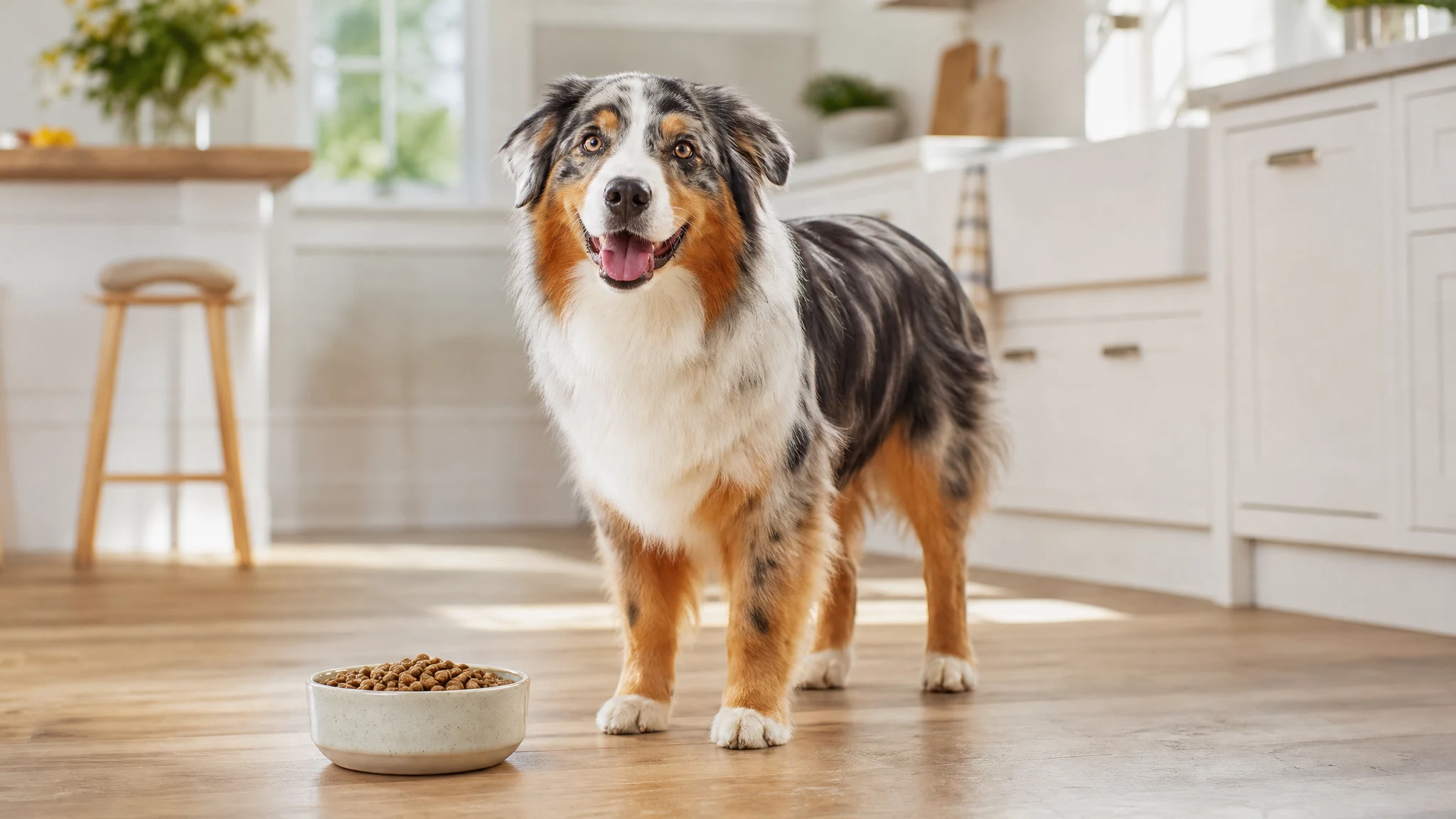
General nutrition information compiled from product labels and published sources, not veterinary advice. Your veterinarian is the right person to choose a diet for your dog, especially one with a health condition.
Every few months a new ranking appears promising the top 10 best dry dog food for your dog. Most of them look alike. They show a numbered list, a few photos and confident claims. Few explain how the foods were chosen.
This guide gives you a repeatable way to read any such list with your Australian Shepherd in mind. It uses only what is printed on a bag or a brand's own product page. It does not rely on taste tests, feeding trials or opinions.
What You Need
- The list you want to judge, open in a browser.
- The brand's own product page for each food that interests you.
- Your dog's current weight, age and body condition. A veterinarian can help with body condition.
- A notepad or spreadsheet with columns for the AAFCO statement, life stage, protein, fat, calories per cup and first five ingredients.
- About 30 minutes.
Step 1: Find Out How the List Was Made
Scroll to the end of the article and look for a method. A trustworthy list says what it compared. A weak one only says "our favorites."
Be wary if the page claims the writers fed every food to dogs but shows no details. Be wary too if it ranks foods by taste with no data behind the ranking. A ranking number from 1 to 10 is an opinion unless the criteria are stated.
For comparison, our own approach is to compare label data only. We did not run feeding trials or taste tests, and you should treat any list that skips this honesty with caution. You can see that method applied in our label-by-label comparison of foods for Australian Shepherds.
Step 2: Match the Food to Your Aussie's Size
Most lists are written for "dogs" in general. Your dog is an Australian Shepherd, which Wikipedia lists at about 35 to 70 lb (16 to 32 kg) as an adult. The Royal Canin breed library describes males at roughly 50 to 65 lb and females at roughly 40 to 55 lb.
That matters because foods are often sized by weight. Royal Canin's Medium formulas, for example, are written for adult weights of 23 to 55 lb. A large male Aussie can sit above that range. Hill's Science Diet Large Breed Adult formulas are written for ideal weights of 55 to 110 lb, which fits only the biggest Aussies.
Size labels are a starting point, not a verdict. If a list recommends a food for "all dogs," check the product page for its stated weight range, then ask your veterinarian which fits your dog.
Step 3: Check the AAFCO Statement and Life Stage
This is the most useful line on any bag. The AAFCO statement says whether the food is complete and balanced, and for which life stage.
The wording varies. Royal Canin Medium Adult says it is formulated to meet the AAFCO Dog Food Nutrient Profiles for maintenance. That makes it an adult food. Victor Chicken Meal & Brown Rice says it meets the profiles for all life stages. Victor Hi-Pro Plus says all life stages, but "except for growth of large size dogs (70 lb. or more as an adult)."
That last phrase is easy to miss. Nom Nom and JustFoodForDogs use the opposite wording, "including growth of large size dogs." Cornell's Riney Canine Health Center advises a commercial large-breed puppy diet with an AAFCO growth adequacy statement and no extra calcium. Because most Aussies stay under 70 lb, a general growth or all-life-stages food is the usual match. The large-size wording matters most for dogs at the top of the breed's weight range.
Royal Canin lists Aussie life stages as puppy to 12 months, adult from 1 to 7 years, mature from 7 to 10 years and senior from 10 years. That is a manufacturer's breakdown, not a veterinary or club standard, so ask your veterinarian about timing.
Step 4: Compare Protein, Fat and Calories Fairly
Copy the numbers from each brand's page into your notepad. Then check two things before comparing.
First, check the basis. Royal Canin and Victor publish a guaranteed analysis, which gives minimums for protein and fat. Hill's pages show typical nutrient values on a dry matter basis, not guaranteed minimums. Those two kinds of numbers are not directly comparable, so do not rank them side by side.
Second, check calories per cup. A food with more calories per cup means a smaller portion, so cup volume alone says little.
| Food (dry) | AAFCO life stage | Protein min | Fat min | kcal per cup |
|---|---|---|---|---|
| Royal Canin Medium Adult | Maintenance | 23.0% | 12.0% | 340 |
| Victor Chicken Meal & Brown Rice | All life stages | 24.0% | 12.0% | 372 |
| Victor Hi-Pro Plus | All life stages, except large-size growth | 30.0% | 20.0% | 406 |
These figures come from each brand's own product page. The table is an example of how to organize your notes. It is not a ranking, and we have not fed these foods to any dog.
Higher is not automatically better. A 30% protein, 20% fat food packs more calories into each cup, which may suit a very active dog and may not suit a dog that gains weight easily. Your veterinarian can judge that for your dog.
Step 5: Read the First Five Ingredients
Ingredients are listed by weight before cooking, so the first few tell you the base of the recipe. Compare them as facts, not as good or bad.
- Royal Canin Medium Adult lists brewers rice, chicken by-product meal, oat groats, wheat and corn protein meal.
- Victor Chicken Meal & Brown Rice lists chicken meal, grain sorghum, peas, whole grain millet and whole grain brown rice.
- Victor Hi-Pro Plus lists beef meal, grain sorghum, chicken fat, whole grain millet and blood meal.
A list that praises "real chicken first" but ignores the rest of the panel is selling a simple idea. A meal is not automatically worse than a fresh meat, and a by-product is not automatically a flaw. They are different label terms. Judge the whole panel and the AAFCO statement together.
Step 6: Watch for Health Claims
Some lists say a food supports joints, protects the heart or fights allergies. Treat that as a red flag. A food cannot be shown on its label data to prevent or treat a disease, and a veterinarian decides what suits an individual dog.
The grain-free and heart disease question comes up often. The FDA's investigation into a possible link between certain diets and canine dilated cardiomyopathy (DCM) was last updated on December 23, 2022. The FDA said it would not issue further public updates until there is meaningful new scientific information, and it does not treat report numbers as proof of cause. If a list makes strong claims either way, ask your veterinarian.
Prescription diets are different again. Only a veterinarian prescribes them, and no "top 10" list can do that for you.
Step 7: Use the Feeding Guide as a Starting Point
Each brand's feeding guide is a label estimate. Royal Canin says its guide is only a guide, and Hill's says to adjust amounts to maintain optimal weight. Begin near the listed amount for your dog's weight, then adjust with your veterinarian based on body condition and energy.
Common Mistakes to Avoid
- Trusting rank order. Position 1 versus position 4 usually reflects the writer's choice, not a measured difference.
- Comparing mismatched numbers. Typical dry matter values and guaranteed minimums are different measurements.
- Ignoring size ranges. A food built for 23 to 55 lb dogs may not match a 65 lb male Aussie.
- Skipping the AAFCO statement. Without it you cannot tell whether a food is for adults, puppies or all life stages.
- Treating breed marketing as proof. We did not find a US-sold breed-specific Australian Shepherd dry formula from Royal Canin. If a list names one, check the brand page yourself.
- Switching foods suddenly. Change foods gradually and ask your veterinarian about the schedule.
Tips
- Open the brand's own page for every food and ignore the list's summary of it.
- If the page lacks a value, such as kibble size, write "unknown" and check with the brand.
- Ask your veterinarian about drug sensitivity too. Aussies can carry the MDR1 gene, which the OFA describes under multiple drug sensitivity. That affects medications, not food, but it is worth raising at the same visit.
What to Expect
After this exercise you should be able to tell which entries on a list are backed by label data and which are only opinion. You may also end up with a shorter list of foods that suit your dog's size and life stage, and a clearer set of questions for your veterinarian.
It will not tell you which food is best for your dog. Individual dogs respond differently, and results vary. Use your notes as a starting point for that conversation.
Sources
- Royal Canin, Medium Adult Dry Dog Food
- Royal Canin, Australian Shepherd breed library
- Hill's Science Diet, Adult Large Breed Dry
- Victor, Hi-Pro Plus
- Victor, Chicken Meal & Brown Rice Formula
- Cornell University Riney Canine Health Center, Panosteitis in dogs
- FDA CVM, Investigation into Potential Link between Certain Diets and Canine DCM
- OFA, Multiple Drug Sensitivity
- Wikipedia, Australian Shepherd