Australian Shepherd Puppy Food: What to Look for on the Label
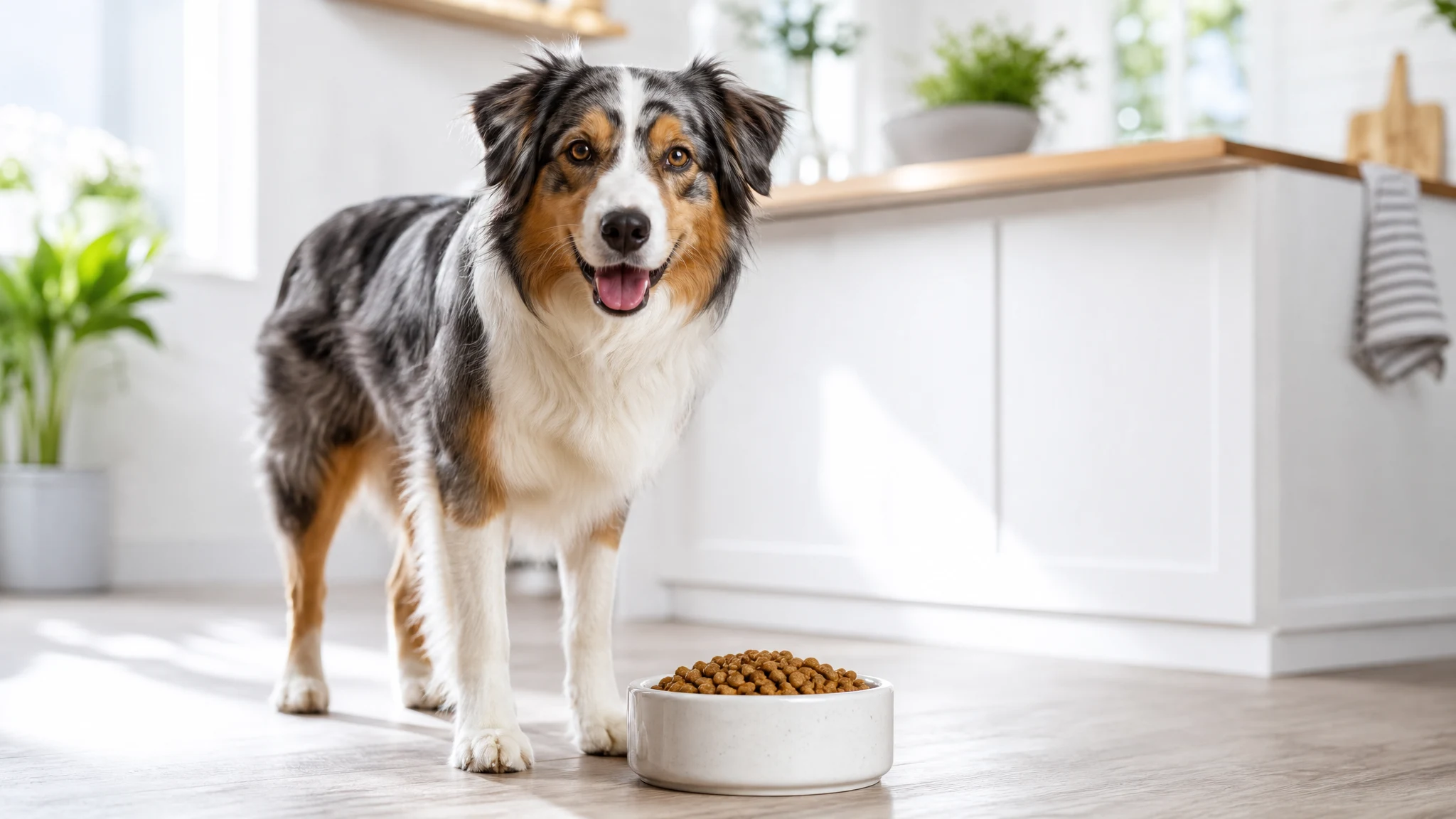
General nutrition information compiled from product labels and published sources, not veterinary advice. Your veterinarian is the right person to choose a diet for your dog, especially one with a health condition.
Choosing Australian Shepherd puppy food is mostly a reading job. The front of the bag tells a story. The back tells you what the food actually is.
This guide walks you through the label in order. It uses label data from the brands' own pages. We compared labels only. We did not run feeding trials or taste tests, and nothing here says a food will prevent or treat any condition.
What You Need Before You Start
- The bag or the brand's product page for each food you are considering.
- Your puppy's age in months.
- A rough guess at adult size. Wikipedia lists the breed at 35 to 70 lb (16 to 32 kg) as adults.
- A kitchen scale or measuring cup, so you can follow the feeding guide later.
- A note to ask your veterinarian about anything specific to your puppy.
Step 1: Find the AAFCO Adequacy Statement
This is the most useful sentence on the bag. It says whether the food is complete and balanced, and for which life stage.
For a puppy, look for wording such as "formulated to meet the nutritional levels established by the AAFCO Dog Food Nutrient Profiles for growth" or "for all life stages." A statement that says "for maintenance" or "adult maintenance" is for adult dogs. It is not a puppy food.
Royal Canin Medium Adult, for example, carries a maintenance statement. Royal Canin Medium Puppy carries a growth statement, according to the brand's product pages.
Step 2: Check the Large-Size Growth Wording
Some "all life stages" labels add a short phrase about big puppies. Two versions exist:
- "including growth of large size dogs (70 lb. or more as an adult)"
- "except for growth of large size dogs (70 lb. or more as an adult)"
Victor Hi-Pro Plus uses the "except" version on its product page. Nom Nom Chicken Cuisine and JustFoodForDogs Pantry Fresh Chicken & White Rice use the "including" version.
Most Aussies stay under 70 lb, so the "except" wording may not matter for many puppies. It matters more for a puppy likely to land at the top of the breed range. Cornell's Riney Canine Health Center advises a large-breed puppy diet with an AAFCO growth statement and no extra calcium for dogs in that situation. Ask your veterinarian where your puppy is likely to end up.
Step 3: Match the Food to Your Puppy's Life Stage
Royal Canin's breed page for the Australian Shepherd lists puppyhood as birth to 12 months, adult as 1 to 7 years, mature as 7 to 10 years and senior from 10 years. That is a manufacturer's guide, not a veterinary rule, so treat the ages as approximate.
Royal Canin Medium Puppy is labeled for puppies up to 12 months. Its sizing is for adult weights of 23 to 55 lb. Royal Canin's own breed page puts adult males at about 50 to 65 lb, so a larger Aussie may sit above that range. This is a good question for your veterinarian.
Step 4: Read the Guaranteed Analysis, Carefully
Protein and fat are listed as minimums, and fiber as a maximum. Higher is not automatically better. These numbers tell you what is in the food, not how your puppy will do on it.
Compare dry foods only with dry foods. Fresh and canned foods hold much more water, so their percentages look small. Hill's lists typical values on a dry matter basis rather than a guaranteed analysis, so those numbers cannot be lined up directly with a bag's minimums.
Step 5: Look at Calories Per Cup
Calories decide how much you scoop. A food at 410 kcal per cup needs a smaller portion than one at 340. Compare the kcal figure, not the bag weight.
Step 6: Read the First Five Ingredients
Ingredients are listed by weight before cooking. The first five give a general picture, but they do not tell you about quality or how your puppy will respond.
Look for what the protein source is, and whether it is a named meat or a meal. A "meal" is a rendered, concentrated ingredient. That is not a fault, only a different form. Also note whether grains appear, since the label simply states them.
Label Comparison for Puppy-Suitable Foods
The table below uses data from each brand's own product page. Kibble size was not stated on the pages we opened. Check the bag if size matters for your puppy's mouth.
| Food | AAFCO wording | Protein | Fat | Calories | First ingredients |
|---|---|---|---|---|---|
| Royal Canin Medium Puppy (dry) | Growth (large-size coverage not confirmed on the page we opened) | 30.0% min | 18.4% min | 410 kcal per cup | Chicken by-product meal, chicken fat, brewers rice, corn, wheat |
| Victor Hi-Pro Plus (dry) | All life stages, except growth of large size dogs | 30.0% min | 20.0% min | 406 kcal per cup | Beef meal, grain sorghum, chicken fat, whole grain millet, blood meal |
| Victor Chicken Meal & Brown Rice (dry) | All life stages | 24.0% min | 12.0% min | 372 kcal per cup | Chicken meal, grain sorghum, peas, whole grain millet, whole grain brown rice |
| Nom Nom Chicken Cuisine (fresh) | All life stages, including large-size growth | 6.5% min | 4.5% min | 244 kcal per cup | Chicken, sweet potatoes, squash, spinach, dicalcium phosphate |
| JustFoodForDogs Pantry Fresh Chicken & White Rice (pouch) | All life stages, including large-size growth | 6.5% min | 2.5% min | 31 kcal per oz (387.5 kcal per 12.5 oz pack) | Chicken breast, chicken thighs, chicken liver, long-grain white rice, kale |
The fresh foods look low in protein because of water content, not because they are weaker foods. Do not compare their percentages to the dry foods. Compare calories instead.
Royal Canin Medium Adult, Royal Canin Medium Digestive Care and the Hill's Science Diet Large Breed formulas covered here carry adult maintenance statements. We did not include them in the table because they are not puppy foods. For a side-by-side of those, see our label comparison of dog foods for Australian Shepherds.
Step 7: Use the Feeding Guide as a Starting Point
Every brand prints a feeding chart. Royal Canin Medium Puppy lists amounts by age in months and adult target weight. Treat the chart as a starting point, not a rule.
Weigh your puppy regularly, adjust with your veterinarian's input, and measure by weight when you can. Royal Canin itself notes that grams are the most accurate form of measurement and that cups are approximate.
Step 8: Change Foods Slowly
When you switch, mix a little of the new food into the old one and shift the ratio over about a week. If your puppy has loose stools or refuses food, slow down and call your veterinarian.
Tips
- Write the statement, protein, fat, calories and first five ingredients on one page for each food. Differences show up fast.
- Use the brand's own page to confirm the current label. Formulas change.
- Keep treats small. They add calories that the feeding guide does not count.
- Ask your veterinarian before adding supplements or extra calcium. Cornell advises against extra calcium for growing large-breed puppies.
Common Mistakes to Avoid
- Buying an adult maintenance food for a puppy. The statement should say growth or all life stages.
- Judging by the front of the bag. Words like "natural" or "premium" are not a guide to nutrition.
- Comparing dry and fresh percentages directly. Water content distorts them.
- Assuming a breed name means a better fit. We did not find a breed-specific Australian Shepherd dry formula sold in the US. Size-based formulas are what most owners use.
- Chasing a diet for a health worry. OFA notes that Aussies can carry MDR1 drug sensitivity, which affects medications, not food. Diet claims about hip dysplasia, allergies or heart disease belong in a conversation with your veterinarian. The FDA's investigation into diets and canine dilated cardiomyopathy (DCM) was last updated on December 23, 2022, and the FDA does not treat report numbers as proof of cause.
What to Expect
If the label matches your puppy's life stage and you feed in line with the guide, many owners see steady growth, normal stools and a healthy appetite. Results vary from puppy to puppy, and a label cannot promise any outcome.
Check your puppy's body condition at each veterinary visit. If growth, stools or energy seem off, your veterinarian decides whether the food should change. Prescription diets are something only a veterinarian prescribes.
Sources
- Royal Canin, Medium Puppy Dry Dog Food
- Royal Canin, Medium Adult Dry Dog Food
- Royal Canin, Australian Shepherd breed library
- Victor, Hi-Pro Plus
- Victor, Chicken Meal & Brown Rice Formula
- Nom Nom, Chicken Cuisine
- JustFoodForDogs, Pantry Fresh Chicken & White Rice Recipe
- Hill's Science Diet, Adult Large Breed
- Cornell University Riney Canine Health Center, Panosteitis in dogs
- FDA, Investigation into Potential Link between Certain Diets and Canine DCM
- OFA, Multiple Drug Sensitivity
- Wikipedia, Australian Shepherd