Switching an Australian Shepherd Puppy From Puppy to Adult Food
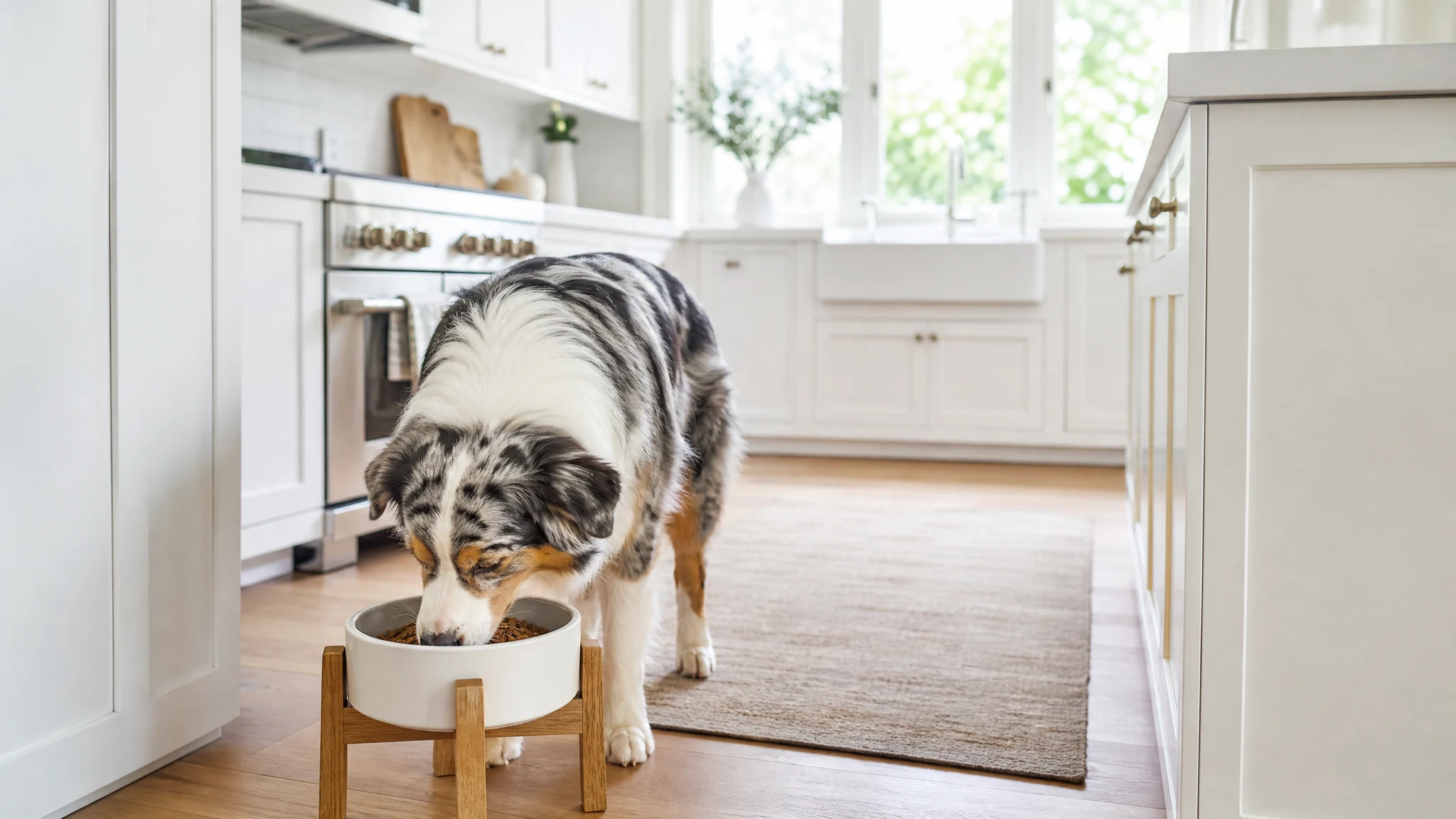
General nutrition information compiled from product labels and published sources, not veterinary advice. Your veterinarian is the right person to choose a diet for your dog, especially one with a health condition.
Moving an Aussie from puppy food to adult food is a small change that is easy to get wrong. Do it too fast and you may see loose stools. Do it too early and a growing dog may miss out on a growth-formulated diet. This guide covers australian shepherd puppy feeding at the changeover: when to switch, what to check on the label, and how to blend the two foods step by step.
We compared label data from brand pages for this article. We did not run feeding trials or taste tests, so treat the product examples as ways to read a label, not as rankings.
When is an Australian Shepherd ready for adult food?
There is no single date. The Royal Canin US breed library for the Australian Shepherd lists the puppy stage as birth to 12 months and the adult stage as 1 to 7 years. That is a manufacturer's guide, not a veterinary or breed club rule, so use it as a rough marker.
Size matters too. Wikipedia lists the adult Australian Shepherd at 35 to 70 lb (16 to 32 kg). The Royal Canin breed page profile puts males at about 50 to 65 lb and females at about 40 to 55 lb. Most Aussies finish growing in the mid-size range, so many do not need a large-breed puppy formula.
A dog at the top of that range is a different case. Ask your veterinarian when your own puppy should change foods. Do this especially if your dog is large for the breed, is growing unevenly, or has a health condition.
What you will need
- The puppy food your dog is eating now, with enough left to last the whole changeover.
- The new adult food, bought in a bag you can finish. Avoid a very large bag until you know your dog likes it.
- A measuring cup, or a kitchen scale. Royal Canin's own feeding note says grams are the most accurate form of measurement and cups are only approximate.
- A clean container or bowl for mixing each day's portion.
- A notebook or phone note to log stool quality, appetite and energy.
- The feeding guide on the new bag, and your veterinarian's phone number.
Step 1: Check the label before you buy
The most important line is the AAFCO nutritional adequacy statement. It tells you which life stage the food is formulated for.
- Adult maintenance: Royal Canin Medium Adult says it is formulated to meet the AAFCO Dog Food Nutrient Profiles for maintenance. That is an adult-only food.
- All life stages: Victor Chicken Meal & Brown Rice Formula states it meets the AAFCO profiles for all life stages. An all-life-stages food can be fed to puppies and adults.
- The large-size wording: Victor Hi-Pro Plus says it covers all life stages "except for growth of large size dogs (70 lb. or more as an adult)." Nom Nom Chicken Cuisine and JustFoodForDogs Pantry Fresh say "including growth of large size dogs." The first wording is not a large-breed puppy food. The second is.
Cornell University's Riney Canine Health Center advises a commercial large-breed puppy diet with an AAFCO growth (or growth and lactation) statement and no extra calcium for puppies expected to be large. Most Aussies stay under 70 lb, so a general growth or all-life-stages food is the usual match. The large-size wording matters mainly for dogs at the top of the breed's weight range.
Step 2: Compare calories, not just protein
Puppy foods are usually more energy-dense than adult foods. That means a cup of the new food may deliver fewer calories than a cup of the old one. The brand pages show this clearly:
| Food (brand page data) | Stage | Calories per cup |
|---|---|---|
| Royal Canin Medium Puppy | Puppy, up to 12 months | 410 kcal ME (calculated) |
| Royal Canin Medium Adult | Adult maintenance | 340 kcal ME (calculated) |
| Royal Canin Medium Digestive Care | Adult maintenance | 321 kcal ME (calculated) |
| Victor Chicken Meal & Brown Rice | All life stages | 372 kcal |
The Royal Canin Medium formulas are size-based, for dogs with an adult weight of 23 to 55 lb. A large male Aussie can sit above that range. Royal Canin's page for the breed is a manufacturer source, so confirm the right size formula with your veterinarian.
Hill's Science Diet Adult Large Breed is written for dogs with an ideal weight of 55 to 110 lb. Its page lists 365 kcal per cup. That may fit a bigger Aussie, but it is an adult food and a poor match for a dog that is still growing.
Step 3: Set the daily amount from the new bag
Start with the feeding guide printed on the new food, and use your dog's current weight and activity level. Treat the number as a starting point. Hill's says to adjust amounts as necessary to maintain optimal weight and to ask your veterinarian if you are unsure.
Aussies are active herding dogs, so a dog with a lot of daily exercise may need more than a dog with a quiet routine. For age-based portions during the puppy months, see our feeding chart by age.
If your dog has a health condition, confirm amounts with your veterinarian before you change anything.
Step 4: Blend the foods gradually
A gradual blend is the common approach. The brands here do not publish one shared schedule, so the split below is a general starting point, not a label rule. Check the new bag for any transition directions, and ask your veterinarian if your dog has a sensitive stomach.
- Days 1 and 2: about 75 percent puppy food and 25 percent adult food.
- Days 3 and 4: about half and half.
- Days 5 and 6: about 25 percent puppy food and 75 percent adult food.
- Day 7 onward: all adult food, if stools and appetite have stayed normal.
Measure the combined portion to match the daily total from Step 3. Do not just add the new food on top of a full serving of the old one. Mix well so your dog cannot pick out the old kibble.
If your dog's stools soften at any point, hold at the current ratio for a few more days before moving on. Some dogs do better with a slower swap over two weeks or more.
Step 5: Keep the meal routine steady
Do not change the schedule and the food on the same day. Keep meal times consistent and feed measured portions rather than leaving food out all day. Royal Canin's feeding notes for the Medium Digestive Care and Weight Care foods give amounts as a daily total by weight and activity level, and the Freshpet page says its food can be fed as one meal or divided into two. Splitting the daily amount into two meals is a common choice for an adult dog, but follow your veterinarian's advice for your own dog.
Step 6: Watch your dog for two to three weeks
Log these points each day:
- Stool firmness and frequency.
- Appetite and how fast your dog eats.
- Energy and coat condition.
- Body shape. You should be able to feel the ribs under a light covering, and see a waist from above.
If your dog gains too much or looks too lean, adjust the portion in small steps. A veterinarian can score body condition and tell you what is right for your individual dog.
Tips for a smoother switch
- Finish the puppy bag first. Using the last of it as the blend base avoids waste and keeps the plan simple.
- Count treats. Training treats add calories. If you train with rewards every day, reduce meals slightly so the total stays steady.
- Keep the protein source familiar if you can. Moving from a chicken-based puppy food to a chicken-based adult food changes fewer things at once. Always read the first five ingredients on both labels.
- Do not add calcium or other supplements on your own. Cornell's advice for growing dogs is to avoid extra calcium. Ask your veterinarian before adding anything to a complete and balanced food.
- Check any medication notes. The OFA notes that MDR1 drug sensitivity can occur in the breed. It is not a diet issue, but it affects deworming and medication, so mention it to your veterinarian when you discuss routine care.
Common mistakes to avoid
- Switching all at once. A sudden swap is a common cause of an upset stomach.
- Using the old cup size. Calorie density differs between foods, as the table shows.
- Switching too early because of size. A big-looking 8-month-old may still be growing. Look at age and your veterinarian's advice, not just appearance.
- Choosing by marketing words. Terms like "premium" or "natural" are not nutrition data. Read the AAFCO statement, the ingredients and the calories.
- Assuming grain-free is better. The FDA's most recent update on its investigation into diets and canine dilated cardiomyopathy is dated December 23, 2022. The agency says it will not issue further public updates until there is meaningful new scientific information, and it does not treat report numbers as proof of cause. Talk to your veterinarian about heart health and diet choices instead of guessing.
- Treating a food as medicine. No everyday food treats or prevents hip dysplasia, eye conditions or allergies. Prescription diets are something only a veterinarian prescribes.
What to expect
Many dogs move to a new food within a week or two without trouble. Mild changes in stool can happen and often settle as the gut adjusts. Your dog may also eat the new kibble with more or less enthusiasm, which varies from dog to dog.
Over the following weeks, a well-matched food and a correct portion may help your Aussie hold a steady, lean body weight. Results depend on the individual dog, its activity and its health.
When to call your veterinarian
Contact your veterinarian if your dog has repeated vomiting, diarrhea lasting more than a day or two, blood in the stool, refuses food, or seems lethargic. Do the same if you are unsure whether your dog is ready to leave puppy food, or if your dog has a health condition that affects what it can eat.
Sources
- Royal Canin US breed library, Australian Shepherd
- Wikipedia, Australian Shepherd
- Cornell University Riney Canine Health Center, Panosteitis in dogs
- FDA CVM, Investigation into Potential Link between Certain Diets and Canine DCM
- OFA, Multiple Drug Sensitivity
- Royal Canin Medium Adult product page
- Royal Canin Medium Puppy product page
- Hill's Science Diet Adult Large Breed product page
- Victor Hi-Pro Plus product page
- Victor Chicken Meal & Brown Rice Formula product page