Stretching a Dog Food Budget for a Large Breed Like the Australian Shepherd
General nutrition information compiled from product labels and published sources, not veterinary advice. Your veterinarian is the right person to choose a diet for your dog, especially one with a health condition.
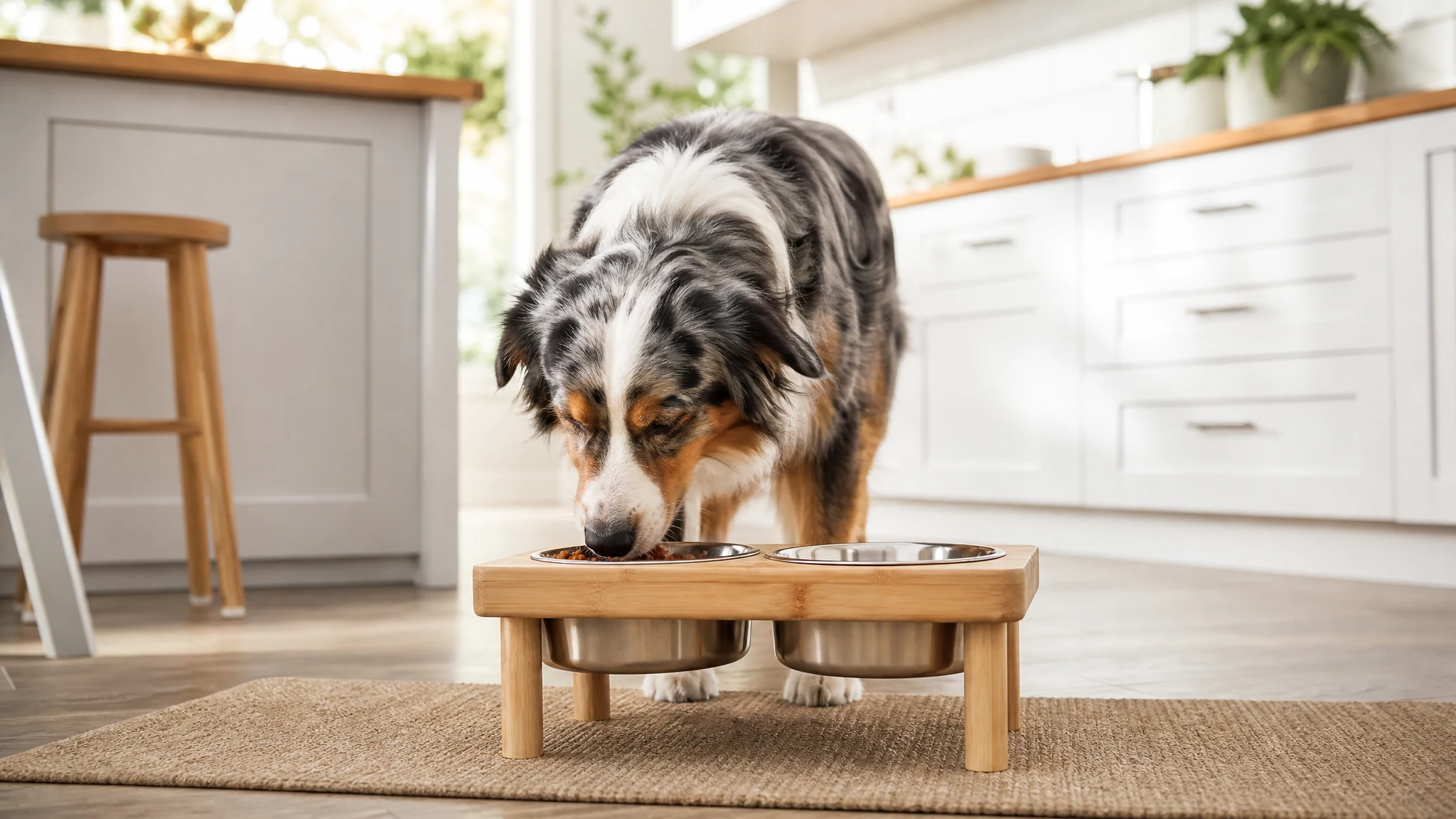
An Australian Shepherd is not a giant breed. Wikipedia lists adults at 35 to 70 lb (16 to 32 kg). Still, an active, muscular herding dog eats a lot over a year, and the cost adds up.
The best budget dog food is not the cheapest bag. It is the food that meets your dog's life stage, keeps a healthy body shape, and costs the least per day to feed. This guide shows how to work that out from the label.
A note on method: we compared label data from brand pages. We did not run feeding trials or taste tests, and we have not fed any of these foods. Prices change by store, so this guide gives you a way to do the math rather than quoting any.
What you need
- Your dog's current weight from a home or vet scale
- Your dog's age and a rough activity level (couch-leaning, regular walks, or daily running and work)
- The bag or product page for each food you are considering
- A kitchen scale or a standard measuring cup
- A calculator and the price you would actually pay for each bag
- A notepad or phone note to track weight and body condition
Step 1: Settle the basics with your vet
Before comparing foods, confirm your dog's ideal weight and body condition with a veterinarian. Budget decisions are easier when you know whether your dog needs to gain, lose or hold steady.
This matters most if your dog has a health condition. A veterinarian decides what an individual dog should eat, and prescription diets are only something a veterinarian prescribes. Do not swap to a cheaper food for a dog on a prescribed diet without asking first.
It also helps to know that Australian Shepherds can carry MDR1 drug sensitivity, according to the OFA. That is not a food issue, but it affects medications, so mention it at any vet visit.
Step 2: Match the food to your dog's life stage
Paying for the wrong formula wastes money. Look for the AAFCO nutritional adequacy statement on the label. It should say the food is formulated for your dog's stage, such as growth, adult maintenance or all life stages.
Royal Canin's Australian Shepherd breed page describes puppyhood as birth to 12 months, adulthood as 1 to 7 years, a mature stage from 7 to 10 years and senior from 10 years. That is a manufacturer's breakdown, not a veterinary or club standard, so treat the ages as a rough guide.
For puppies, Cornell's Riney Canine Health Center advises a commercial large-breed puppy diet with an AAFCO growth adequacy statement and no extra calcium. Aussies are usually under 70 lb as adults. A growth or all-life-stages food is therefore a common match, and the large-size wording matters most for dogs near the top of the weight range.
You will see two wordings on labels. "Including growth of large size dogs (70 lb. or more as an adult)" means the food meets the large-size growth rule. "Except for growth of large size dogs" means it is not meant for large-breed puppies. Victor Hi-Pro Plus carries the "except" wording, for example. Ask your vet which fits your puppy.
Step 3: Compare cost per day, not cost per bag
This is the step that saves the most money. A bag that costs less can still cost more each day if it is less calorie dense and you pour more of it.
- Find the calories per cup on the product page. Some pages list calories per kilogram instead.
- Find your dog's daily amount from the feeding guide (see Step 5).
- Work out how many days one bag lasts at that amount.
- Divide the bag price by the number of days.
Here is what the brand pages list for a few dry foods, as examples of how much density varies:
| Food | Calories per cup | Life stage statement |
|---|---|---|
| Royal Canin Medium Adult | 340 kcal ME | Adult maintenance |
| Victor Chicken Meal & Brown Rice | 372 kcal | All life stages |
| Hill's Science Diet Adult Large Breed Chicken & Barley | 365 kcal | Adult maintenance |
| Victor Hi-Pro Plus | 406 kcal | All life stages, except growth of large size dogs |
Fresh foods are far less dense. Freshpet's Home Cooked Chicken Recipe lists 189 kcal per cup, and Nom Nom's Chicken Cuisine lists 244 kcal per cup. Your dog would need more volume to reach the same calories, so run the same cost-per-day math before deciding.
Step 4: Read the label past the front of the bag
Marketing words do not change nutrition. Check these items instead:
- The adequacy statement. "Complete and balanced" should be tied to a life stage.
- The first ingredients. Victor Chicken Meal & Brown Rice lists chicken meal first. Royal Canin Medium Adult lists brewers rice first. Neither is automatically better or worse. The list simply tells you what the food is built from.
- The analysis numbers. Royal Canin and Victor list guaranteed minimums and maximums. Hill's pages show typical values on a dry matter basis, so those numbers are not directly comparable to a guaranteed analysis.
Be cautious about paying extra for trends. The FDA's investigation into a possible link between certain diets and canine dilated cardiomyopathy (DCM) had its latest update on December 23, 2022. The FDA says it will not post more public updates until there is meaningful new scientific information, and it does not treat report numbers as proof of cause. If you are worried about your dog's heart or diet type, talk with your vet rather than choosing by headline.
Step 5: Measure every meal
Overfeeding is the quiet budget leak. A bag runs out faster when scoops are generous, and extra weight is a health cost too.
Use the feeding guide on the product page as a starting point, based on your dog's weight and activity. Royal Canin notes that its guide is only a guide and that grams are more accurate than cups. Hill's says to adjust amounts to maintain optimal weight and to ask your veterinarian if unsure.
Our feeding chart by age for Australian Shepherds explains how age and activity shift portions. Split the daily amount into two meals, and reweigh your dog every few weeks. If your dog has a health condition, confirm amounts with your vet.
Step 6: Switch foods slowly and track the result
When you change foods to save money, mix the new food into the old one gradually over several days. A sudden switch can upset the stomach, and a vet visit for that erases any savings.
After the switch, keep notes on your dog's weight, stool quality, coat and energy. Give the new food a fair trial before judging it.
Tips for stretching the budget
- Count treats as part of the daily calories and trim meals to match. Using part of the regular kibble as training rewards costs nothing extra.
- If your dog is a healthy weight, do not pay for a "weight care" or specialty formula unless your vet recommends it.
- Check the brand's own page for the current feeding guide. Do not rely on a retailer's copy.
- Mixing a small amount of a fresh or wet food into dry is an option some owners use. Royal Canin's site says wet and dry can be fed together. Reduce the dry portion to match so total calories do not creep up.
- Buy a size you can finish before the food goes stale, since wasted food is wasted money.
Common mistakes to avoid
- Judging by price per pound. Calorie density and portion size decide the real daily cost.
- Feeding an adult formula to a growing puppy. Check for a growth statement.
- Adding calcium or other supplements to stretch nutrition. Cornell specifically warns against extra calcium for growing large-breed puppies. Ask your vet before adding any supplement.
- Ignoring size labels. Royal Canin's Medium formulas are written for dogs with adult weights of 23 to 55 lb. A large male Aussie can sit above that range, so check the feeding guide against your dog's actual weight.
- Switching formulas constantly chasing sales. It makes it hard to tell what is working.
What to expect
If you match the life stage, measure portions and compare cost per day, you may find a food that costs less per day to feed. Your dog may also hold a steadier weight. Results vary by dog, and no food can promise a particular health outcome. No food prevents or treats hip dysplasia, allergies or any other condition, and an Aussie's needs can change with age and activity.
If your dog loses or gains weight, has loose stools that last, or seems itchy or low on energy after a switch, call your vet. The cheapest food is the one that keeps your dog well.
Sources
- Wikipedia, Australian Shepherd
- Royal Canin, Australian Shepherd breed library
- Cornell University Riney Canine Health Center, Panosteitis in dogs
- OFA, Multiple Drug Sensitivity
- FDA CVM, Investigation into Potential Link between Certain Diets and Canine DCM
- Royal Canin, Medium Adult Dry Dog Food
- Hill's Science Diet, Adult Large Breed Chicken & Barley
- Victor, Hi-Pro Plus
- Victor, Chicken Meal & Brown Rice Formula
- Freshpet, Home Cooked Chicken Recipe
- Nom Nom, Chicken Cuisine