Setting a Feeding Schedule for an Adult Australian Shepherd
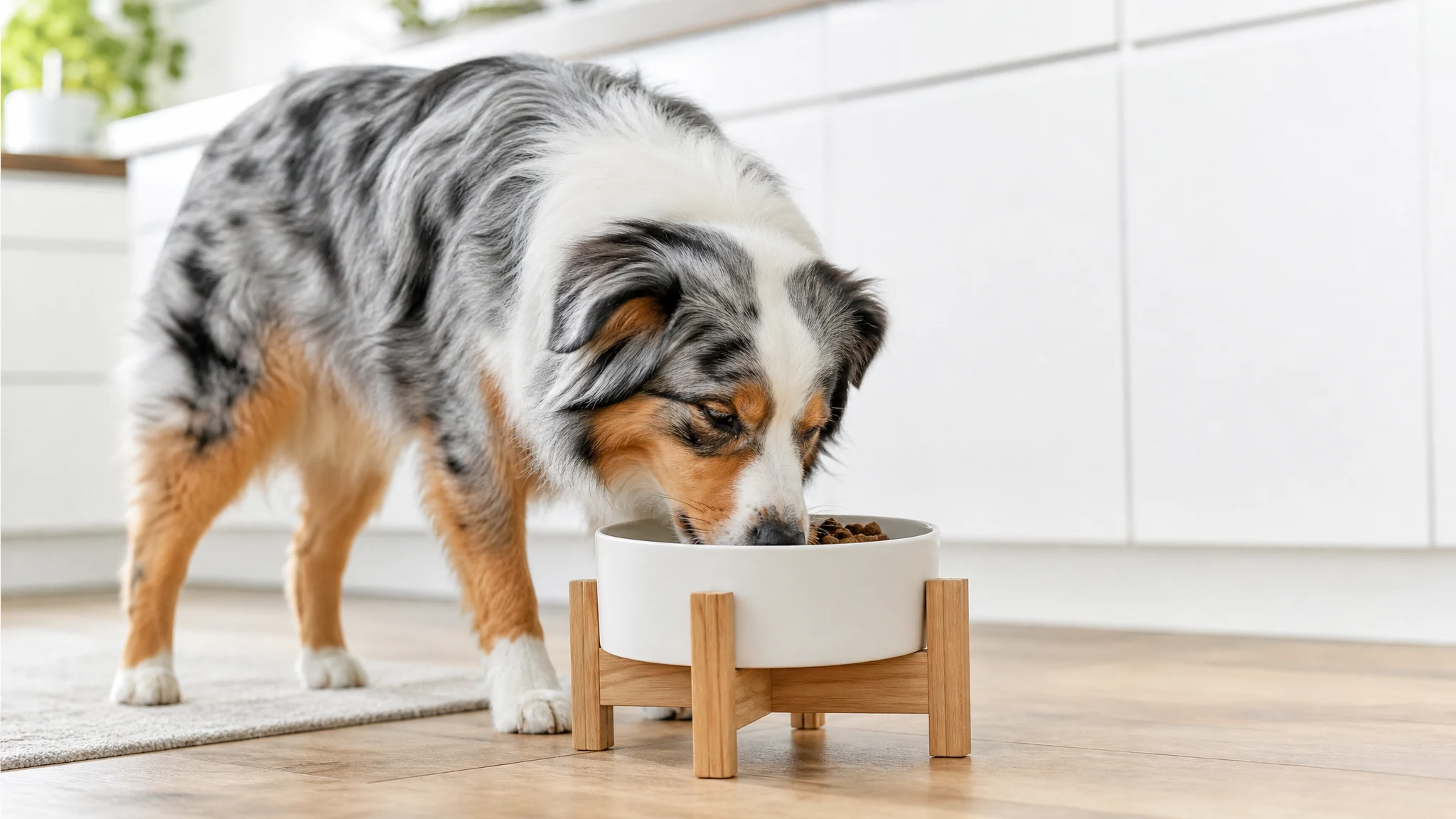
General nutrition information compiled from product labels and published sources, not veterinary advice. Your veterinarian is the right person to choose a diet for your dog, especially one with a health condition.
A good Australian Shepherd feeding schedule is mostly about routine. You pick a food, find a starting amount on its label, split it into meals, and adjust based on how your dog looks and feels over a few weeks.
This guide walks through that process. It relies on label data from the brands named below. We compared label data only. We did not run feeding trials or taste tests, and we are not telling you which food to buy.
What You Need Before You Start
- Your dog's current weight. Adult Australian Shepherds typically fall between 35 and 70 lb (16 to 32 kg), according to Wikipedia. The Royal Canin breed library lists males at about 50 to 65 lb and females at about 40 to 55 lb. Your own dog's weight matters more than any breed average.
- The food's label or the brand's product page. You need the AAFCO statement, the calories per cup, and the feeding guide.
- A measuring cup, ideally a kitchen scale. Royal Canin's feeding guide notes that grams are the most accurate form of measurement and that cup amounts are approximate.
- A notebook or phone note to record meal times, amounts and your dog's weight.
- A clean bowl and a quiet spot where your dog can eat without interruption.
Step 1: Confirm Your Dog Is at the Right Life Stage
Royal Canin's breed library describes Australian Shepherd life stages this way: puppy from birth to 12 months, adult from 1 to 7 years, mature from 7 to 10 years, and senior from 10 years. That source is a manufacturer, not a veterinary or breed club, so treat the ages as a rough guide.
This article is for adults. If your dog is still a puppy, or is entering the mature years, amounts and food choices can change. Our feeding chart by age covers those stages in more detail.
Step 2: Check the Food Is Complete and Balanced for Adults
Look for the AAFCO statement on the bag. For an adult dog, it should say the food meets the AAFCO Dog Food Nutrient Profiles for maintenance or for all life stages.
Here are a few examples of how the wording appears on brand pages:
- Royal Canin Medium Adult states it is formulated to meet AAFCO levels for maintenance.
- Victor Chicken Meal & Brown Rice Formula states it meets AAFCO levels for all life stages.
- Freshpet's Home Cooked Chicken Recipe states it meets AAFCO levels for adult maintenance.
Any of these wordings is fine for an adult. The statement tells you the food is meant to be a complete diet, so you do not need to add extras to make it nutritionally balanced.
Step 3: Find the Calories Per Cup
Two foods can look alike in the bowl and differ a lot in calories. The brand pages list these values:
| Food (brand page) | Calories stated |
|---|---|
| Royal Canin Medium Adult (dry) | 340 kcal ME per cup |
| Victor Chicken Meal & Brown Rice (dry) | 372 kcal per cup |
| Victor Hi-Pro Plus (dry) | 406 kcal per cup |
| Freshpet Home Cooked Chicken Recipe (fresh) | 189 kcal per cup |
The same scoop of Hi-Pro Plus carries noticeably more calories than a scoop of Royal Canin Medium Adult. If you switch foods, do not assume your old cup measure still fits. Recheck the label.
Step 4: Use the Label's Feeding Guide as a Starting Point
Find your dog's weight on the manufacturer's feeding table. Royal Canin and Freshpet both publish charts or calculators based on weight, and Royal Canin's digestive care chart also factors in activity level (low, medium or high).
Treat that number as a starting point, not a rule. Royal Canin itself says its guide is only a guide. Hill's says to adjust amounts as necessary to maintain optimal weight, and to ask your veterinarian if you are unsure.
One size note: Royal Canin's Medium formulas are sized for adults of 23 to 55 lb. A larger male Aussie can sit above that range. Hill's large breed adult formulas are labeled for ideal weights of 55 to 110 lb. Neither is wrong for an Aussie, but check which range your dog falls in and what the brand suggests.
Victor's Hi-Pro Plus is labeled for all life stages except growth of large size dogs (70 lb or more as an adult). That exception concerns puppies, so it matters little for an adult.
Step 5: Split the Daily Amount Into Meals
Many owners feed twice a day, morning and evening, by dividing the daily amount in two. Freshpet's page, for example, says its food can be fed as one meal daily or divided into two. Brands do not require one pattern over another, so pick what suits your household.
A simple Australian Shepherd feeding schedule might look like this:
- First meal after the morning routine, at roughly the same time each day.
- Second meal in the early evening, about 10 to 12 hours later.
- Water available all day.
If your dog has a medical condition, such as a history of digestive trouble, ask your veterinarian how to space meals. Do not assume one pattern fits every dog.
Step 6: Account for Activity and Treats
Australian Shepherds are a working breed, and activity varies a lot between dogs. A dog that herds, runs agility or hikes most days may need more than a dog that mostly lounges. That is why some feeding guides ask you to pick low, medium or high activity.
Treats count too. If you train with treats, small pieces add up, so consider taking them out of the daily meal amount. Keep chews and table scraps modest.
Step 7: Track Weight and Body Condition for a Few Weeks
Write down your dog's weight when you start, then weigh every two weeks or so. Also look at your dog from above and from the side. You should be able to feel the ribs under a light covering, and see a waist behind the ribs. Your veterinarian can show you how to score body condition.
If weight is climbing or dropping, change the daily amount in small steps and watch for a couple of weeks before changing again. Brand charts, including Hill's, say outright that amounts may need adjusting to maintain optimal weight.
Step 8: Change Foods Gradually
If you move to a new food, mix it with the old one over several days, increasing the new share a little at a time. This gentle approach is common advice, though your veterinarian can tailor it to your dog. After the switch, recalculate the amount using the new label, since calories per cup will likely differ.
Tips for Making the Schedule Stick
- Feed at consistent times. Dogs settle into routines quickly.
- Measure every meal. Eyeballing tends to drift upward.
- Keep a short list of everything your dog eats, including treats and training rewards.
- Keep one household member in charge of meals, or use a shared note so the dog is not fed twice.
- Give your dog a calm period after meals rather than hard exercise right away. Ask your veterinarian what they recommend for your dog.
Common Mistakes to Avoid
- Using the bag chart as a fixed rule. It is a starting point, and your dog's body condition is the real check.
- Switching foods without recalculating. A cup of one food is not a cup of another.
- Forgetting treats and chews. They add calories that are easy to overlook.
- Adding supplements on your own. A complete and balanced food already covers nutrition. If you think your dog needs a supplement, ask your veterinarian for the product and amount.
- Leaving food out all day. It makes intake hard to track.
- Ignoring medication notes. Australian Shepherds can carry MDR1 drug sensitivity, according to OFA. It is not a diet issue, but it matters for medications and deworming, so mention it to your veterinarian.
When to Talk to Your Veterinarian First
Confirm amounts and timing with your veterinarian if your dog has any health condition, is overweight or underweight, has a sensitive stomach, takes medication, or is pregnant or nursing. A veterinarian decides what is right for an individual dog. Prescription diets are something only a veterinarian prescribes.
No food is shown by these labels to prevent or treat conditions such as hip dysplasia, allergies, heart disease or bloat. For questions about those, rely on your veterinarian.
What to Expect
With a steady routine and measured portions, many owners find that their dog's weight holds fairly steady and mealtimes become predictable. A dog that is fed consistently may also be easier to train with food rewards. Results vary by dog, and a few weeks of notes will show you whether the amount needs a small change.
If your dog's appetite, stools, energy or weight change suddenly, contact your veterinarian rather than adjusting the schedule yourself.
Sources
- Wikipedia, Australian Shepherd
- Royal Canin US breed library, Australian Shepherd
- OFA, Multiple Drug Sensitivity
- Royal Canin, Medium Adult Dry Dog Food
- Hill's Science Diet, Adult Large Breed Chicken & Barley Recipe
- Victor, Hi-Pro Plus
- Victor, Chicken Meal & Brown Rice Formula
- Freshpet, Fresh From the Kitchen Home Cooked Chicken Recipe