Overfeeding an Australian Shepherd Puppy: Signs to Watch For
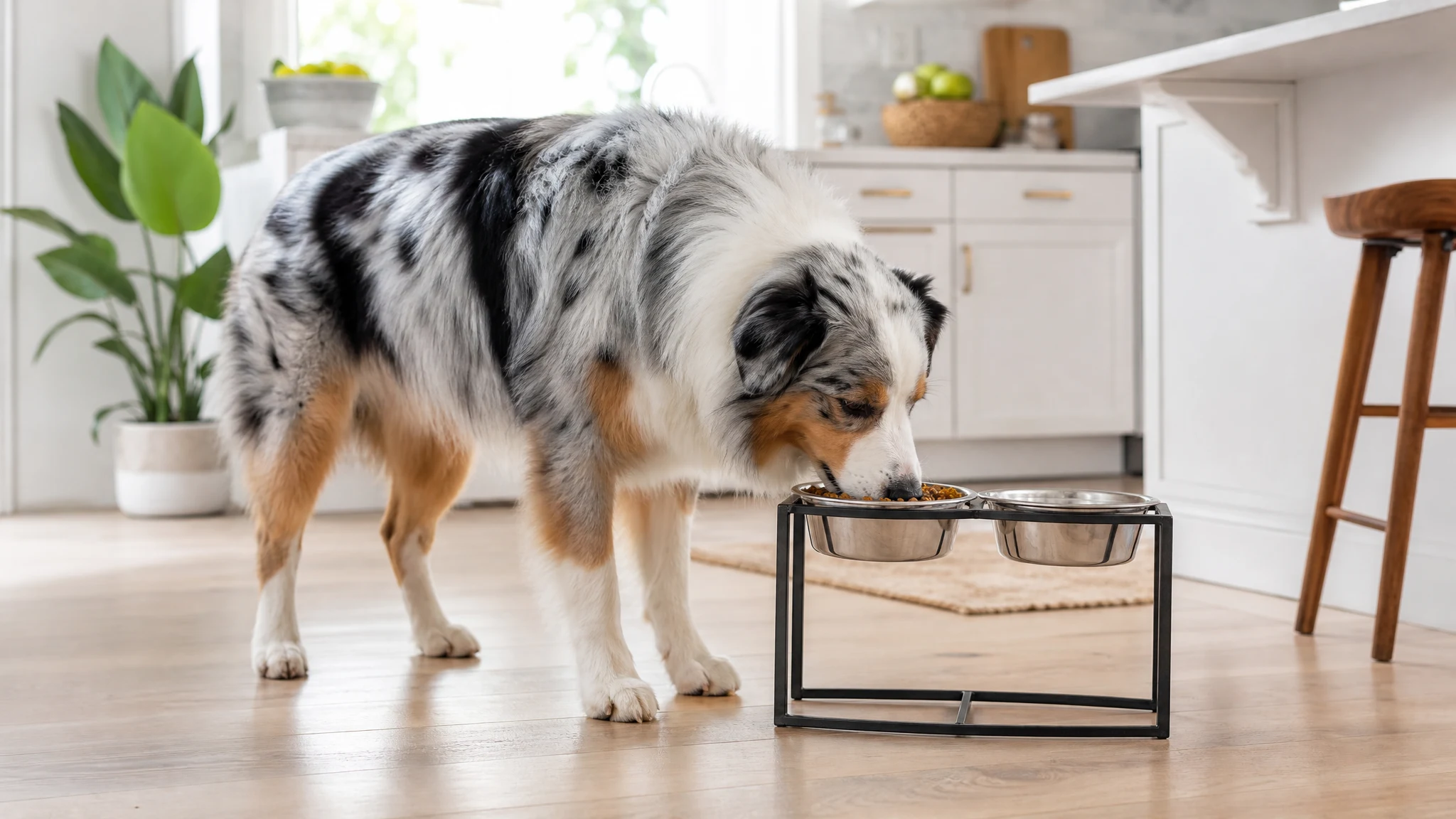
General nutrition information compiled from product labels and published sources, not veterinary advice. Your veterinarian is the right person to choose a diet for your dog, especially one with a health condition.
Australian Shepherd puppies are busy, eager and quick to learn that a food bowl means a good time. That makes it easy to scoop a little extra, or to say yes to one more treat. This guide shows you how to check whether your puppy is getting too much, and how to adjust calmly if so.
The right Australian Shepherd puppy food amount depends on your puppy's age, current weight, expected adult weight and activity. No single number fits every dog, so this guide is a method, not a prescription.
What You Need
- The bag or can your puppy eats, with its feeding guide and calorie statement.
- A measuring cup, ideally a kitchen scale too. Royal Canin's feeding guide notes that grams are the most accurate form of measurement and that cups are only approximate.
- A notebook or phone note to log meals, treats and weight.
- A puppy-safe scale or your vet's scale for regular weigh-ins.
- A treat jar, so you can see how many treats go out each day.
Why the Amount Matters for This Breed
Wikipedia lists the adult Australian Shepherd at about 35 to 70 lb (16 to 32 kg). Royal Canin's breed page describes males at roughly 50 to 65 lb and females at roughly 40 to 55 lb. That is a wide range, so two puppies of the same age can need quite different portions.
Royal Canin's breed page also treats the first 12 months as the puppy stage for this breed. Puppy foods are richer than adult foods, so the same scoop carries more calories. Royal Canin Medium Puppy, for example, lists 410 kcal ME per cup (as fed, calculated) on its product page, while Royal Canin Medium Adult lists 340 kcal per cup. Switching foods without re-checking the portion is a common way to overshoot.
Step-by-Step: How to Check for Overfeeding
Step 1: Read the label guide as a starting point
Find the feeding chart on your puppy's food. Most charts, such as the one for Royal Canin Medium Puppy, are organized by the puppy's age in months and expected adult weight. Pick the row that matches your puppy, then treat the result as a starting amount, not a fixed rule.
If you are unsure of the adult weight, use the middle of the breed range as a rough guess and ask your vet to refine it. For a broader look at portions by age, see our Australian Shepherd feeding chart by age.
Step 2: Weigh out the real portion for three days
Measure what you actually serve. Many owners find the "cup" they scoop is heavier than the cup on the chart. Weigh it in grams if you can, and write it down.
Add up everything else too: training treats, chews, dental sticks, food used for puzzle toys and table scraps. Those count toward the day's total.
Step 3: Compare your total to the label guide
Compare your daily total, treats included, with the chart amount for your puppy's age and weight. If you are well above it, you have found a likely cause. If you are close to it, the next steps will tell you whether the guide suits your puppy.
Active puppies may need more than the chart and calm ones less. That is why Steps 4 to 6 matter more than the chart alone.
Step 4: Do a hands-on body check
Run your hands along your puppy's sides. In a healthy build, you can feel the ribs under a thin layer of coat and flesh without pressing hard. Look from above: there should be a gentle waist behind the ribs. From the side, the belly should tuck up a little.
The Australian Shepherd's thick double coat can hide extra weight, so rely on touch, not on looks alone.
Step 5: Watch for the common signs
- Ribs are hard to feel. You have to dig through padding to find them.
- No visible waist. The body looks like a tube from above.
- Soft, large or frequent stools. Loose stool can have many causes, including a food change, so mention it to your vet.
- Weight gain that outpaces the plan. Puppies should grow, but a steep jump between weigh-ins is worth a call.
- Slowing down early on walks. Extra weight can make play tiring, though tiredness has other causes too.
- Constant begging after full meals. This is not always hunger. Aussies are smart and learn what works.
- Leftover-free bowl and a hunt for more. Fast eating alone does not prove overfeeding, but pair it with the signs above.
One sign by itself is not a diagnosis. Several together are a good reason to review portions.
Step 6: Track weight on a schedule
Weigh your puppy every one to two weeks and write the number down. Your vet can tell you whether the trend looks right for the expected adult size. Growth should be steady, not rushed.
Cornell University's Riney Canine Health Center advises a commercial puppy diet with an AAFCO growth adequacy statement and no added calcium. For a breed that mostly stays under 70 lb, a general growth or all-life-stages food is the usual match, and the large-breed wording matters mainly for pups at the top of the range. Ask your vet which suits your puppy.
Step 7: Adjust gently and recheck
If your checks suggest too much food, make a small change and keep the schedule steady. Count treats toward the daily total and trim the meals to match. Avoid sudden cuts, and do not stop feeding a growing puppy to "catch up."
Check again after one to two weeks. Share your log with your vet before making larger changes.
A Simple Daily Schedule
Splitting the daily amount into several meals is common for young puppies, and many owners move to fewer meals as the puppy matures. The label of your food and your vet are the best guides to timing. Keep mealtimes regular so you can see what your puppy actually eats.
| Puppy detail | What to use |
|---|---|
| Age in months | Row on the food's feeding chart |
| Expected adult weight | Column on the chart; confirm with your vet |
| Activity level | Nudge up or down based on body checks |
| Treats and chews | Subtract from meals |
Common Mistakes to Avoid
- Scooping by eye. Cups drift. Measure every time.
- Forgetting treats. Training sessions add up fast for a bright, eager puppy.
- Using adult food amounts for puppy food. The calories per cup differ between formulas.
- Adding calcium or other supplements. Cornell advises no extra calcium for growing puppies. Do not add supplements unless your vet recommends them.
- Feeding by the chart for a different breed size. Royal Canin Medium formulas are written for dogs with an adult weight of 23 to 55 lb, so a large male Aussie may sit above that range. Check with the brand or your vet.
- Ignoring family feeding. If several people feed the puppy, use one shared log.
- Using food to stop boredom. Aussies are herding dogs. Play, training and puzzle time often help more than another snack.
Tips for Staying on Track
- Set aside part of the daily kibble for training so treats do not add extra.
- Use a slow-feed bowl or a puzzle toy for mealtimes if your puppy gulps.
- Use the brand's own feeding calculator when one exists, and then confirm the result against your puppy's body check.
- Keep one steady food during growth, and change foods slowly if your vet suggests it.
What to Expect
With measured meals, counted treats and regular weigh-ins, many owners find their puppy's weight gain becomes steadier and the body check improves over a few weeks. Results vary by puppy, and growth spurts can make numbers jump around for a while.
Weight changes do not by themselves prove or rule out any health problem. Food does not prevent or treat disease, and a veterinarian decides what is right for an individual dog.
When to Call Your Vet
Contact your vet if your puppy has ongoing loose stools, vomiting, a sudden change in appetite, rapid weight gain, or any health condition. If your puppy has a health condition, confirm feeding amounts with your vet before changing anything. Also ask the vet about medication and deworming choices, because the breed can carry MDR1 drug sensitivity, as the OFA explains.
How We Compared Food Information
The product details in this guide come from the brands' own product pages. We compared label data only. We did not run feeding trials or taste tests, and we cannot say how any food will work for your puppy.