Mixing Freeze-Dried Raw Into an Australian Shepherd's Regular Diet
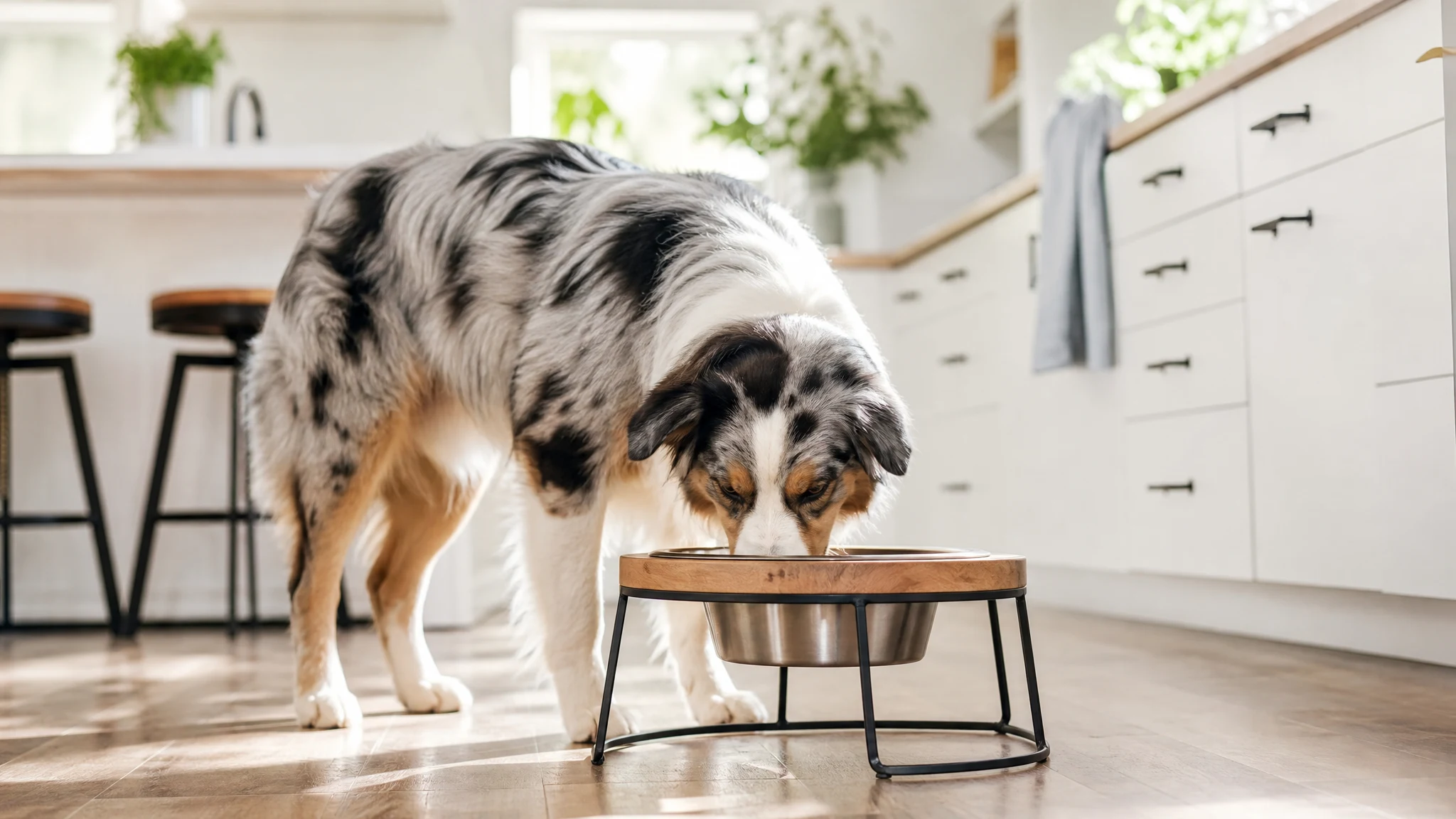
General nutrition information compiled from product labels and published sources, not veterinary advice. Your veterinarian is the right person to choose a diet for your dog, especially one with a health condition.
Many Australian Shepherd owners like the idea of adding a little freeze-dried raw to their dog's usual meals. It can be a way to add variety without changing everything at once. It also adds a few things to check: the label, the calories, and how your dog's stomach handles the change.
This guide walks through the process in order. It does not name a freeze-dried product. We compared label data for other foods, but we did not run feeding trials or taste tests, and we did not test any freeze-dried brand. Use the steps to read any label you are considering.
What "best" means for this food
There is no single best freeze dried raw dog food for every Aussie. A food that suits a 45 lb female on a quiet week may be wrong for a 65 lb male who herds or runs most days. Look for a complete-and-balanced statement, a clear ingredient list, and calorie information you can use. Then decide how it fits your dog.
The Australian Shepherd is listed on Wikipedia at about 35 to 70 lb as an adult. The Royal Canin breed library gives about 50 to 65 lb for males and 40 to 55 lb for females. That is a wide range, so a feeding plan has to start with your own dog's weight and body condition.
What you need
- Your dog's regular food (kibble, canned or fresh) and its label.
- The freeze-dried raw product's label or the brand's own product page.
- A kitchen scale. Grams are more accurate than cups. Royal Canin's own feeding note says the same about its food.
- Clean water and a separate bowl or dish for rehydrating.
- A notebook or phone note to log meals, stools and body weight.
- A separate cutting board, bowl and scoop for raw products, plus soap and hot water for cleanup.
Step-by-step: adding freeze-dried raw to the bowl
Step 1. Check with your veterinarian first if your dog has a health condition
A healthy adult Aussie usually has few restrictions. A dog with kidney, pancreatic, digestive or other health issues may need a different plan. A dog living with a young child, an older person or someone with a weakened immune system also changes the risk picture. Ask your veterinarian before adding raw food, and confirm amounts with them for any dog with a health condition.
Aussies also carry an MDR1 drug sensitivity concern, according to the Orthopedic Foundation for Animals (OFA). That is a medication issue, not a food issue. It is still worth telling your vet about when you discuss diet and any deworming or other medicines.
Step 2. Read the freeze-dried label
Find these items on the package or the brand's own page:
- The AAFCO statement. Look for wording that says the food is formulated to meet the AAFCO Dog Food Nutrient Profiles for adult maintenance, growth or all life stages. A product that says "intermittent or supplemental feeding only" is not meant to be the whole diet.
- Life stage. All-life-stages labels vary. Some say "including growth of large size dogs (70 lb. or more as an adult)" and others say "except for growth of large size dogs." Most Aussies stay under 70 lb, but a dog at the top of the breed range deserves a closer look.
- Calories. Find kcal per cup, per ounce or per piece. If the label does not give calories, check with the brand before you feed it.
- Handling and storage directions. Follow the brand's instructions, not general assumptions.
Be skeptical of broad claims on the front of the bag. Words like "ancestral" or "biologically appropriate" are marketing. They are not nutrition facts.
Step 3. Know your base food's calories
The base food is the part of the diet you are keeping. Find its kcal per cup. For example, the Royal Canin Medium Adult dry food lists 340 kcal ME per cup (as fed, calculated). Victor Chicken Meal & Brown Rice lists 372 kcal per cup. Hill's Science Diet Adult Large Breed Chicken & Barley lists 365 kcal per cup.
Those numbers differ. Freeze-dried foods can be very different again, because removing the water makes the pieces light but dense in calories. Your own food's label is the only number that counts.
Step 4. Set the daily total first
Start from the feeding guide on your dog's regular food, using your dog's weight and activity level. Treat it as a starting point, not a rule. Hill's notes on its pages that you should adjust amounts to maintain an optimal weight. Our Australian Shepherd feeding chart by age covers how age and size change the starting amount.
Life stage matters too. The Royal Canin breed library describes puppyhood as birth to 12 months, adult as 1 to 7 years, mature as 7 to 10 years and senior from 10 years. That source is a manufacturer, not a vet or club, so use it as a rough guide. Your veterinarian can place your own dog.
For a growing puppy, Cornell University's Riney Canine Health Center advises a commercial puppy diet with an AAFCO growth adequacy statement and no extra calcium. For that reason, ask your vet before adding any topper to a puppy's diet.
Step 5. Replace calories, do not just add them
This is the step people skip. If you put freeze-dried pieces on top of a full bowl, the daily total goes up. A herding dog that is active in the yard can still gain weight if the extras add up.
Decide how much of the day's calories the freeze-dried food will cover. Then reduce the regular food by roughly the same calorie amount. If you are unsure how to do the math, ask your vet or the brand's customer line.
Step 6. Start small and go slowly
Begin with a small portion in one meal a day. Keep the rest of the bowl the same. Watch the stool and appetite for several days. If things look normal, you can raise the amount a little at a time. A gradual change is a common approach to any diet switch, and a vet can tailor the pace.
If your dog gets loose stool, vomits, or seems uncomfortable, stop and call your veterinarian.
Step 7. Rehydrate if the brand says to
Some freeze-dried foods are meant to be fed dry. Others are meant to be rehydrated with water first. Follow the brand's instructions. Use the amount of water and the waiting time on the package.
Do not leave rehydrated food sitting out for hours. Ask the brand how long it can stay out, and discard what your dog does not eat within that time.
Step 8. Mix and serve
Stir the freeze-dried portion into the regular food, or place it on top. Dogs that are picky about texture sometimes do better with a little warm water on the kibble to blend the two.
Step 9. Wash up
Raw meat products can carry bacteria. Wash your hands, the bowl, the scoop and any surface the food touched with soap and hot water. Store the package as the label directs. Keep it away from children's reach and from other food.
Tips that help
- Weigh your dog monthly. You can stand on the scale holding your dog, then subtract your own weight. Compare the number with your vet's target weight.
- Feel the ribs. You should be able to feel them under a light layer of coat and body. Ask your vet to show you what a healthy body condition feels like for your dog.
- Change one thing at a time. Do not add a new treat, chew and topper in the same week. If something upsets the stomach, you will not know which one it was.
- Use it as a topper in stages. Some owners use freeze-dried food for training rewards. Count those pieces in the daily total.
- Keep notes. A short log of amounts and stool quality makes vet visits easier.
Common mistakes
- Adding on top of a full bowl. This raises calories without you noticing.
- Treating a topper as a complete diet. Check the AAFCO statement. A food that is not complete and balanced should not be the main meal.
- Switching everything in a day. A fast change is a common cause of an upset stomach.
- Assuming a dog's size from the breed. Aussies range from about 35 to 70 lb. Use your dog's real weight.
- Adding supplements without asking. Extra calcium or other additions can matter, especially in puppies. Ask your vet before adding any supplement, and never guess at an amount.
- Judging by price or packaging. Neither tells you whether the food fits your dog.
- Choosing food for disease protection. No food is shown to prevent or treat hip dysplasia, eye conditions or other health problems in this breed. The OFA, Wikipedia and Royal Canin sources describe those conditions. They do not say a raw diet changes them.
A note on grain-free and DCM
Some freeze-dried foods are grain-free, and owners ask about heart disease. The FDA has an investigation into a potential link between certain diets and canine dilated cardiomyopathy (DCM). Its latest update is dated December 23, 2022. The FDA said it would not issue further public updates until there is meaningful new scientific information, and it does not treat report numbers as proof of cause. If this worries you, ask your veterinarian about your own dog's diet.
What to expect
Results vary from dog to dog, and no food is a guarantee. Some owners report that their dog seems more interested in meals after adding a topper. Others notice no difference. A complete and balanced diet, fed in the right amounts, supports a dog's overall nutrition, but a food does not treat or cure a condition.
A reasonable goal is simple. Your dog eats well, keeps a steady weight, has normal stools and stays energetic. If one of those slips, go back to the regular diet and call your vet.
Quick checklist
- Talk to your vet if your dog has any health condition or is a puppy.
- Read the AAFCO statement and calorie information.
- Set the daily total from your dog's weight, age and activity.
- Reduce the regular food to make room.
- Introduce slowly and log the results.
- Handle raw products with clean habits.
For brand-specific questions about storage, rehydration or calories, contact the brand directly. This page does not have that information for any freeze-dried product.
Sources
- Wikipedia, Australian Shepherd
- Royal Canin US breed library, Australian Shepherd
- Orthopedic Foundation for Animals, Multiple Drug Sensitivity
- Cornell University Riney Canine Health Center, Panosteitis in dogs
- FDA CVM, Investigation into Potential Link between Certain Diets and Canine DCM
- Royal Canin, Medium Adult Dry Dog Food
- Victor, Chicken Meal & Brown Rice Formula
- Hill's Science Diet, Adult Large Breed Chicken & Barley