How Feeding Amounts Change as an Australian Shepherd Ages
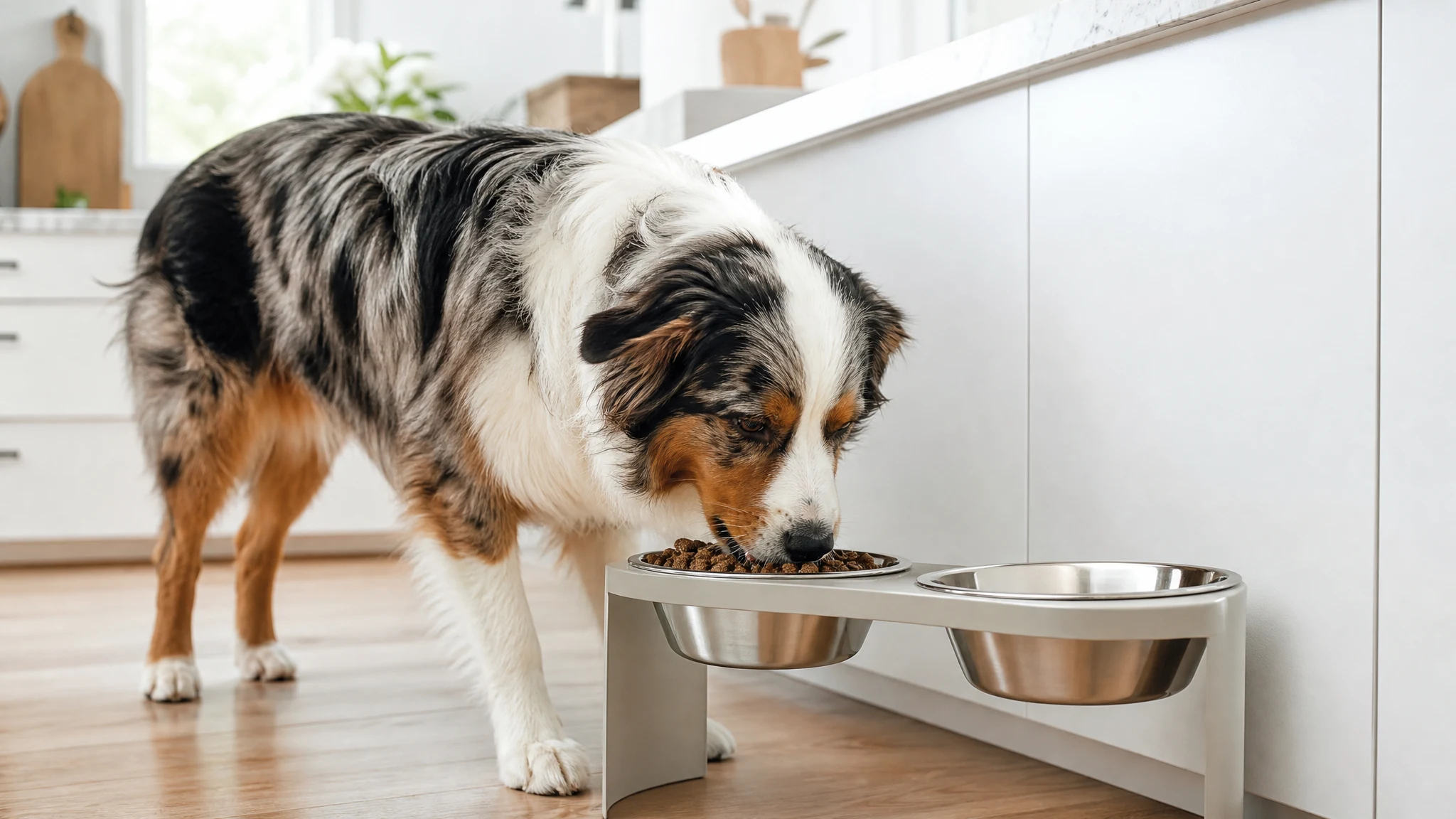
General nutrition information compiled from product labels and published sources, not veterinary advice. Your veterinarian is the right person to choose a diet for your dog, especially one with a health condition.
An Australian Shepherd does not eat the same amount at 4 months, 4 years and 11 years. Growth, activity and body condition all move the number. A food bag can only give a starting point.
This guide shows how to build your own Australian Shepherd feeding chart by age from the label on your dog's food. It explains what to measure, how to adjust, and what mistakes to avoid. For a quick reference, see our Australian Shepherd feeding chart by age.
We did not run feeding trials or taste tests. Everything here comes from manufacturer label data and the veterinary and breed sources listed at the end.
What You Need Before You Start
- The bag or can your dog eats now, with its feeding guide and calorie statement.
- A kitchen scale that reads in grams. Royal Canin notes that grams are the most accurate way to measure, and that cup amounts on its chart are approximate.
- A standard dry measuring cup, if you do not weigh food.
- A bathroom scale or your vet's scale for your dog's weight.
- A notebook or phone note for weight, amounts and treats.
Why Age Changes the Amount
Australian Shepherds are usually listed at 35 to 70 lb (16 to 32 kg) as adults, according to Wikipedia. The Royal Canin breed page describes males at about 50 to 65 lb and females at about 40 to 55 lb. That is a wide range, so two adult Aussies can need quite different amounts.
The Royal Canin breed library also gives life stages for the breed. These come from a manufacturer, not a veterinary or breed club, so treat them as a rough guide:
| Life stage (Royal Canin breed page) | Age | What usually changes |
|---|---|---|
| Puppy | Birth to 12 months | Amounts rise with age and expected adult weight |
| Adult | 1 to 7 years | Amounts follow current weight and activity |
| Mature | 7 to 10 years | Watch for weight creep as activity may slow |
| Senior | 10 years and older | Review body condition and appetite with your vet |
A 2024 UK study cited by Wikipedia reported a median lifespan of 13.7 years for the breed. Many Aussies reach the senior stage, so it is worth planning for.
Step-by-Step: Build Your Dog's Feeding Chart
Step 1: Confirm the food fits the life stage
Find the AAFCO statement on the package. It should say the food is complete and balanced for your dog's stage: growth, maintenance, or all life stages.
For example, Royal Canin Medium Puppy is described on its page for puppies up to 12 months. Royal Canin Medium Adult states it meets AAFCO nutritional levels for maintenance. Victor Hi-Pro Plus states all life stages "except for growth of large size dogs (70 lb. or more as an adult)."
That last wording matters only for dogs near the top of the breed's weight range. Cornell's Riney Canine Health Center advises a commercial large-breed puppy diet with an AAFCO growth adequacy statement and no extra calcium for large-breed puppies. Most Aussies stay under 70 lb, so a general growth or all-life-stages food is the usual match. If your puppy's parents were large, ask your veterinarian which wording to look for.
Step 2: Find the right row on the label chart
Feeding guides use different inputs. The Royal Canin Medium Puppy page lists amounts by age in months and expected adult weight. Its Medium Digestive Care page uses a daily chart by dog weight (26 to 53 lb) and activity level: low, medium or high.
Pick the row that matches your dog's current weight and age. Write down the daily total, not just the per-meal amount.
Size matters here. Royal Canin Medium formulas are written for adult weights of 23 to 55 lb. A large male Aussie can sit above that range, so check whether the chart covers your dog's weight. If it does not, check with the brand.
Step 3: Check the calories
Foods differ a lot in calories per cup, so the same cup can mean very different intakes. These are the figures on the brands' own pages:
| Food (brand page) | Calories on the label |
|---|---|
| Royal Canin Medium Adult | 340 kcal ME per cup |
| Royal Canin Medium Puppy | 410 kcal ME per cup |
| Royal Canin Medium Digestive Care | 321 kcal ME per cup |
| Hill's Science Diet Adult Large Breed Chicken & Barley | 365 kcal per cup |
| Victor Hi-Pro Plus | 406 kcal per cup |
| Victor Chicken Meal & Brown Rice | 372 kcal per cup |
| Freshpet Home Cooked Chicken | 189 kcal per cup |
Moving a dog from a 321 kcal cup to a 406 kcal cup without reducing the volume adds a lot of calories. That is one of the easiest ways to overfeed by accident. The Hill's pages say to adjust amounts as needed to maintain optimal weight, and to ask your veterinarian if unsure.
Check the brand's own page for current numbers. Labels change, and some figures on brand pages are typical values rather than guaranteed minimums.
Step 4: Weigh out the starting amount and split it
Divide the daily total into meals. Feeding guides generally treat the number as a daily total, and many owners split it into two meals. Freshpet's page, for one, says its food can be fed as one meal or divided into two.
For a growing puppy, ask your veterinarian about the number of meals. Our chart page lists a suggested schedule by age.
Step 5: Account for activity
Aussies are a herding breed, and activity varies widely. A dog doing agility or ranch work needs more than a dog with two short walks a day. If the label chart has an activity column, use it honestly. If it does not, begin at the listed weight amount and adjust using the next step.
Step 6: Check body condition and weigh every two to four weeks
Run your hands along your dog's ribs. You should be able to feel them under a thin layer of padding, and see a waist from above. Record the weight at the same time of day.
If weight is climbing, trim the daily amount slightly. If your dog is getting thin, increase slightly. Small changes of around a tenth are easier to judge than big swings. Give any change a few weeks before judging it.
Step 7: Re-run the chart at each life stage
At about 12 months, ask your vet whether it is time to switch from a growth food to an adult food. Around 7 years, recheck weight and body condition. In the senior years, weight loss or changes in appetite deserve a vet visit rather than a bowl adjustment.
When you change foods, do it gradually and watch stool and appetite. Because calories per cup differ between foods, recalculate the amount from the new label rather than reusing the old cup count.
Tips
- Count treats and training rewards. Use part of the daily allowance for training, since Aussies are often highly food-motivated in reward-based training.
- Use the same cup or scale every time. Scoops vary in size.
- Write the date and amount each time you change something.
- Ask your veterinarian before adding any supplement. Do not add calcium to a growing puppy's diet, per Cornell's guidance above.
- MDR1 drug sensitivity is not a diet issue, but the OFA notes it affects medication choices. Mention it to your vet if your dog has not been tested.
Common Mistakes
- Feeding by the bowl, not the label. A "scoop" can be far off a measured cup.
- Using a food sized for another dog. A medium-breed chart with a 23 to 55 lb range may not suit a 65 lb male.
- Keeping puppy amounts too long. Puppy foods are more calorie-dense (Royal Canin Medium Puppy lists 410 kcal per cup, against 340 for its Adult formula).
- Ignoring weight changes in older dogs. Unexplained loss or gain is a reason to call the vet.
- Treating a food as a medical fix. No food prevents or treats hip dysplasia, eye disease, allergies or heart disease. Wikipedia reports a relatively low hip dysplasia prevalence of about 6% in the breed, but diet choices for an individual dog are a veterinary decision. Prescription diets are only something a veterinarian prescribes.
What to Expect
If you follow the steps, your dog's weight may hold steadier and body condition may be easier to keep in a healthy range. Results vary with genetics, activity and health, and no feeding plan can promise a particular outcome.
The label amount is a starting point. Expect to adjust over several weeks. If your Aussie has a health condition, is pregnant or nursing, or is very young or very old, confirm amounts with your veterinarian before you rely on any chart.
The FDA has said it will not issue more public updates on its canine dilated cardiomyopathy (DCM) investigation until there is meaningful new scientific information. Its last update was December 23, 2022, and the agency does not treat report numbers as proof of cause. If you have questions about ingredients and heart health, ask your veterinarian.
Sources
- Wikipedia, Australian Shepherd
- Royal Canin US breed library, Australian Shepherd
- Royal Canin, Medium Adult Dry Dog Food
- Royal Canin, Medium Puppy Dry Dog Food
- Royal Canin, Medium Digestive Care Dry Dog Food
- Hill's Science Diet, Adult Large Breed Chicken & Barley
- Victor, Hi-Pro Plus
- Victor, Chicken Meal & Brown Rice Formula
- Freshpet, Fresh From the Kitchen Home Cooked Chicken Recipe
- Cornell University Riney Canine Health Center, Panosteitis in dogs
- OFA, Multiple Drug Sensitivity
- FDA CVM, Investigation into Potential Link between Certain Diets and Canine DCM