Free Feeding vs Scheduled Meals for Australian Shepherds
General nutrition information compiled from product labels and published sources, not veterinary advice. Your veterinarian is the right person to choose a diet for your dog, especially one with a health condition.
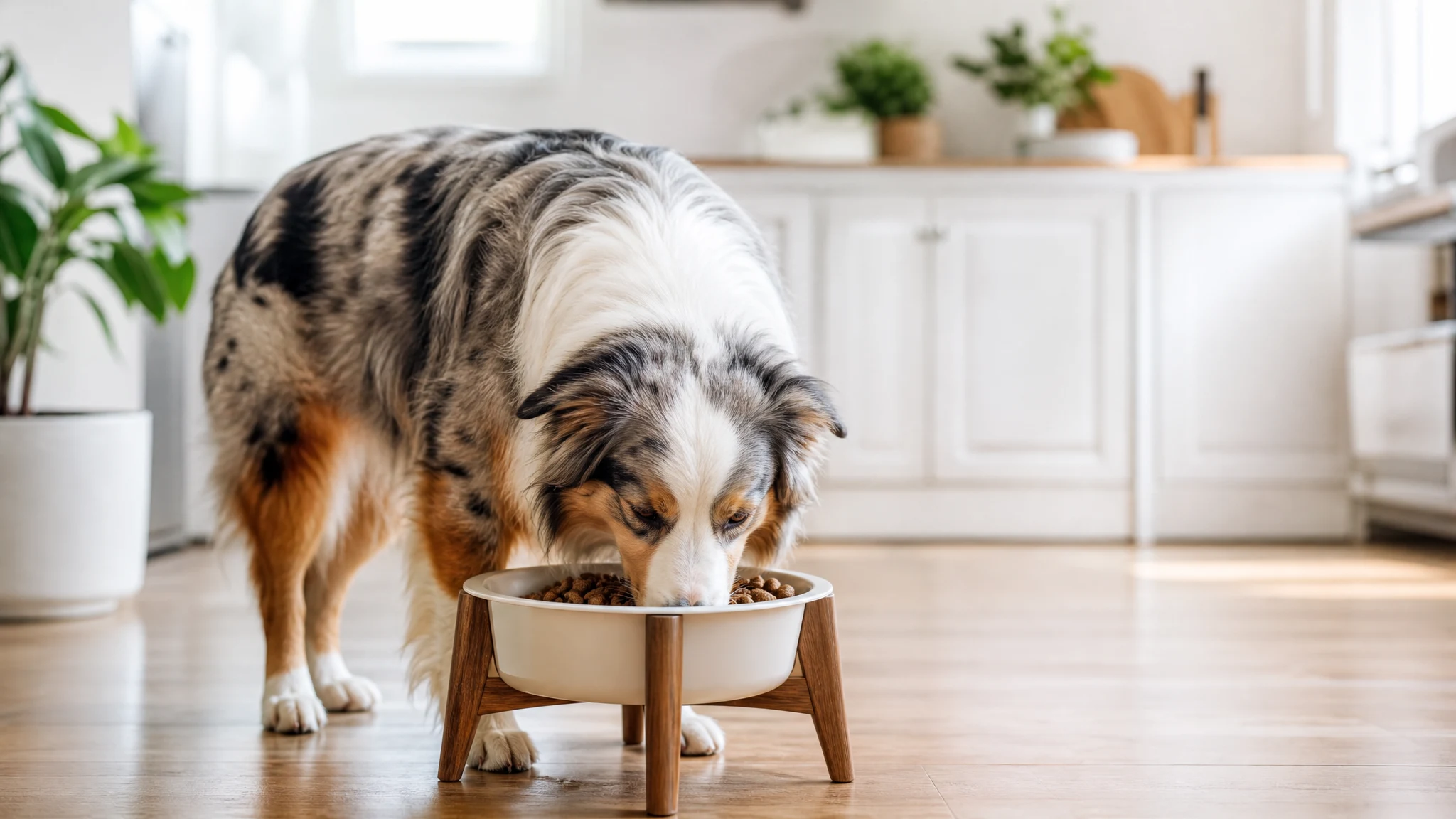
Free feeding means a full bowl is always out. Scheduled feeding means measured meals at set times. For most Australian Shepherd owners, an australian shepherd feeding schedule is easier to control and easier to read. This guide walks through how to switch, step by step.
One note on method. We compared label data from brand pages. We did not run feeding trials or taste tests, and we did not feed any of these foods ourselves.
Free feeding vs scheduled meals: the short version
With free feeding, you cannot easily tell how much your dog eats. A change in appetite is often the first sign that something is off, and it is hard to spot when the bowl is never empty.
Scheduled meals give you a daily amount you can count. They also make it easier to adjust food when your dog's weight or activity changes.
Free feeding can still work for some dogs. It tends to work best for dogs that stop eating on their own and stay lean. Dry food is the usual choice, since fresh and canned foods should not sit out. Whichever you pick, a veterinarian decides what is right for an individual dog.
| Question | Free feeding | Scheduled meals |
|---|---|---|
| Easy to measure intake? | No | Yes |
| Spot appetite changes? | Harder | Easier |
| Works with fresh or canned food? | Generally not | Yes |
| Fits a work schedule? | Very flexible | Needs set times |
What you need
- A measuring cup, or better, a kitchen gram scale. Royal Canin's own feeding guide says grams are the most accurate measure and cups are only approximate.
- The food's feeding guide from the bag or the brand's own page.
- A way to weigh your dog, such as a home scale or a vet visit.
- A notebook or phone note for meal times, amounts and weight.
- A clean bowl and a quiet spot to eat.
Step-by-step: set up an Australian Shepherd feeding schedule
Step 1. Note your dog's life stage, weight and activity
Royal Canin's breed library for the Australian Shepherd lists puppy as birth to 12 months, adult as 1 to 7 years, mature as 7 to 10 years, and senior from 10 years. That is a manufacturer's breakdown, not a veterinary or club standard, so treat it as a rough guide.
Wikipedia gives the adult weight as 35 to 70 lb (16 to 32 kg). Royal Canin's breed profile lists males at about 50 to 65 lb and females at about 40 to 55 lb. Write down your dog's current weight and how active the dog is on a normal week.
Step 2. Read the feeding guide on your food
Every complete food has a feeding guide. Treat it as a starting point, not a target. Royal Canin's Medium Adult page says its chart is only a guide. Hill's says to adjust amounts as needed to maintain optimal weight, and to ask your veterinarian if you are unsure.
Find your dog's weight on the chart. Note the daily amount, then adjust for activity if the chart allows it. For puppies, Royal Canin's Medium Puppy page lists amounts by age in months and expected adult weight. For exact amounts by age, see our feeding chart by age.
Step 3. Check the calories, not just the cups
Foods differ a lot in calories per cup. These are the figures on the brand pages:
- Royal Canin Medium Adult: 340 kcal ME per cup (calculated).
- Victor Chicken Meal & Brown Rice Formula: 372 kcal per cup.
- Victor Hi-Pro Plus: 406 kcal per cup.
- Freshpet Home Cooked Chicken Recipe: 189 kcal per cup (calculated).
A cup of one food is not a cup of another. If you switch brands, use the new food's own guide instead of copying the old cup count.
Step 4. Pick the number of meals and the times
We found no source in our research that sets a required number of meals for the breed. The feeding guides we reviewed give a daily total, and Freshpet's page says its food can be fed as one meal or divided into two.
A practical choice is to split the daily total into equal meals and feed at the same times each day. Pick times you can keep on workdays and weekends. For a puppy, ask your veterinarian how many meals suit the dog's age.
Step 5. Measure and serve
Weigh or measure the full day's food each morning. Set aside what is for treats, if you use them, and take that from the total. Serve each meal in the bowl, then leave it down for a set window, such as 15 to 20 minutes. Pick up what is left.
Do not top up the bowl between meals. Keep the routine boring. A predictable routine helps most dogs settle.
Step 6. Move from free feeding gradually
If your dog is used to a full bowl, start by measuring what the dog normally eats over a day or two. Then move toward the label's starting amount over several days. Do this in steps, not overnight.
If you change the food itself at the same time, introduce it slowly so you can tell what is causing any stomach upset. Ask your veterinarian about the best pace for your dog.
Step 7. Watch the dog and adjust
Weigh the dog every few weeks and look at body shape. You should be able to feel the ribs under a light covering. If weight creeps up or drops, change the daily amount by a small step and recheck.
Aussies are active working-type dogs, so a busy season may call for a bit more food and a quiet one for less. Write down changes so you can see the pattern.
Tips
- Count treats and chews. They add calories that the feeding guide does not include.
- Feed in a calm spot, and give the dog a rest after a meal rather than hard exercise. Ask your veterinarian about the best timing for your dog.
- Keep fresh water available at all times.
- Use the same measuring tool every time. A scoop that is a little heavy adds up over weeks.
- If you mix wet and dry food, reduce each so the total matches the daily target. Royal Canin's site says wet and dry can be fed together.
Common mistakes to avoid
- Trusting cups blindly. Cups are approximate, and the same cup holds different calories in different foods.
- Using the wrong life-stage food. Adult maintenance foods are not meant for growth. Check the AAFCO statement on the label. Victor Hi-Pro Plus, for example, is labeled for all life stages "except for growth of large size dogs (70 lb. or more as an adult)." Cornell's Riney Canine Health Center advises a growth-appropriate commercial diet for large-breed puppies with no extra calcium. Most Aussies stay under 70 lb, but a dog at the top of the 35 to 70 lb range is worth discussing with your veterinarian.
- Skipping the size check. Royal Canin Medium formulas are written for dogs with an adult weight of 23 to 55 lb. A large male Aussie may sit above that range, so check the product page.
- Changing too much at once. Change the schedule or the food in separate steps when you can.
- Treating a chart as a rule. It is a starting point. Your dog's body condition is the better guide.
Health conditions and medications
If your dog has a health condition, confirm amounts and meal timing with your veterinarian before changing anything. No food prevents, treats or cures a disease, and prescription diets come only from a veterinarian.
Many Aussies carry the MDR1 gene change that causes drug sensitivity, according to the OFA. It is not a food issue, but it matters for medications, so mention it at the vet.
We could not confirm from an opened veterinary or club source that Aussies are especially prone to bloat or obesity. Ask your veterinarian what applies to your dog.
What to expect
Many owners find that set meals make appetite changes easier to notice and portions easier to track. Some dogs may settle into the routine within a week or two, though this varies. Weight and energy may become steadier over several weeks as you fine-tune the amount.
None of this is certain. Some dogs do well free fed, and some need extra adjustment. If appetite, stool or weight changes in a way that worries you, call your veterinarian.
Sources
- Royal Canin US breed library, Australian Shepherd
- Royal Canin, Medium Adult Dry Dog Food
- Royal Canin, Medium Puppy Dry Dog Food
- Hill's Science Diet, Adult Large Breed
- Victor, Hi-Pro Plus
- Victor, Chicken Meal & Brown Rice Formula
- Freshpet, Home Cooked Chicken Recipe
- Cornell Riney Canine Health Center, Panosteitis in dogs
- OFA, Multiple Drug Sensitivity
- Wikipedia, Australian Shepherd