Australian Shepherd Feeding Chart by Age: Puppy to Senior
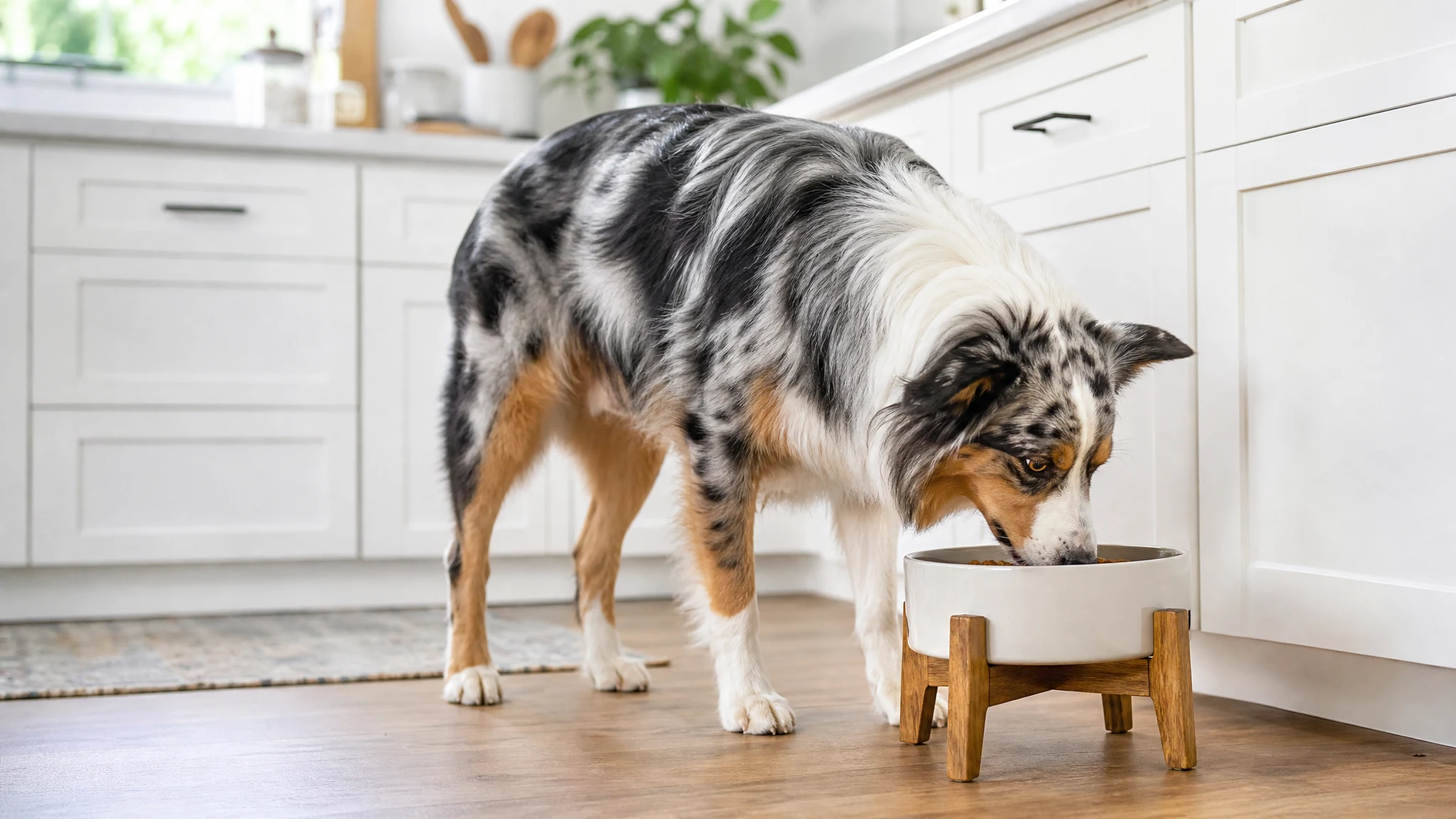
General nutrition information compiled from product labels and published sources, not veterinary advice. Your veterinarian is the right person to choose a diet for your dog, especially one with a health condition.
An Australian Shepherd does not eat the same way at 4 months as at 9 years. The food, the amount and the checks all change as the dog moves through life stages.
This guide shows how to build your own australian shepherd feeding chart by age, using the food label as your starting point. It does not give one fixed number for every dog, because no honest chart can. Weight, activity and health all matter.
For a deeper look at portions, see our companion page on how much to feed an Australian Shepherd at each age.
How we compared the food
We compared label data published on each brand's own product page: the AAFCO statement, first ingredients, protein, fat, fiber and calories. We did not run feeding trials or taste tests, and we have not fed these foods to dogs. Nothing here says one food is best. It shows how to read what is printed.
Materials you will need
- The bag, can or tub your dog eats now, with its feeding guide and AAFCO statement.
- A measuring cup, or better, a kitchen scale. Royal Canin notes on its feeding guides that grams are the most accurate form of measurement and that cups are only approximate.
- Your dog's current weight, from a home scale or your veterinary clinic.
- A notebook or phone note to record weight, portions and treats.
- Your veterinarian's contact, for any health question.
The life stages at a glance
The Royal Canin US breed library for the Australian Shepherd lists these life stages for the breed: puppy from birth to 12 months, adult from 1 to 7 years, mature from 7 to 10 years, and senior from 10 years. That is a manufacturer's view, not a veterinary or breed club ruling, so treat the ages as a rough guide. Your vet can tell you when your own dog has moved on.
| Life stage | Rough age (Royal Canin breed library) | What to look for on the label |
|---|---|---|
| Puppy | Birth to 12 months | An AAFCO statement for growth or all life stages |
| Adult | 1 to 7 years | A statement for maintenance or all life stages |
| Mature | 7 to 10 years | A maintenance or all life stages statement; watch weight and ask your vet |
| Senior | 10 years and up | The same, with your vet guiding any change |
The adult weight range is 35 to 70 lb (16 to 32 kg), according to Wikipedia. Royal Canin's breed profile puts males at about 50 to 65 lb and females at about 40 to 55 lb. Many Aussies sit in the middle of those ranges, but individual dogs vary.
Step-by-step: build your Aussie's feeding chart
Step 1: Identify the life stage
Use the table above and your dog's birthday. A dog just past 12 months may still be filling out, so ask your vet before switching foods near a stage boundary.
Step 2: Read the AAFCO statement
This one sentence tells you which life stage the food is built for. Here are examples taken from the brands' pages:
- Royal Canin Medium Puppy is for puppies up to 12 months and states it is formulated for growth.
- Royal Canin Medium Adult states it is formulated for maintenance, for adult dogs over 12 months.
- Victor Chicken Meal & Brown Rice Formula states it is formulated for all life stages.
- Victor Hi-Pro Plus is for all life stages "except for growth of large size dogs (70 lb. or more as an adult)."
That last phrase matters for puppies. The wording "including growth of large size dogs" is the other form you may see. Nom Nom Chicken Cuisine and JustFoodForDogs Pantry Fresh Chicken & White Rice both use it. Cornell's Riney Canine Health Center advises a commercial large-breed puppy diet with an AAFCO growth adequacy statement and no extra calcium. Most Aussies finish under 70 lb, so a general growth or all life stages food is the usual match. The large-size wording matters most for a pup headed for the top of the range. Ask your vet which applies to yours.
Step 3: Check the size category
Royal Canin's Medium formulas are written for adult weights of 23 to 55 lb. A large male Aussie can sit above that. Hill's Science Diet Adult Large Breed foods are written for dogs with an ideal weight of 55 to 110 lb, which fits larger Aussies better than smaller ones. No Australian Shepherd specific dry formula sold in the US turned up in the brand pages we checked, so size-based foods are the practical route. Check with the brand if you want to confirm.
Step 4: Compare calories, not only cups
A cup of one food is not a cup of another. These are the calorie figures printed on the brand pages:
| Food | Stated calories |
|---|---|
| Royal Canin Medium Puppy (dry) | 410 kcal ME per cup |
| Royal Canin Medium Adult (dry) | 340 kcal ME per cup |
| Royal Canin Medium Digestive Care (dry) | 321 kcal ME per cup |
| Hill's Science Diet Adult Large Breed Chicken & Barley (dry) | 365 kcal per cup |
| Hill's Science Diet Adult 6+ Large Breed (dry) | 352 kcal per cup |
| Victor Chicken Meal & Brown Rice (dry) | 372 kcal per cup |
| Victor Hi-Pro Plus (dry) | 406 kcal per cup |
| Freshpet Home Cooked Chicken (fresh) | 189 kcal per cup |
| Nom Nom Chicken Cuisine (fresh) | 244 kcal per cup |
Swapping a 340 kcal cup for a 406 kcal cup without changing the volume adds calories quickly. This is why portions should follow the new food's own guide.
Step 5: Use the label guide as a starting point
Find your dog's weight on the feeding guide. Royal Canin's puppy page lists amounts by age in months and adult target weight. Its Digestive Care page gives a daily chart by weight and activity level. Hill's tells owners to adjust amounts as needed to maintain optimal weight and to ask a veterinarian if unsure. Freshpet says its food is fed as one meal daily or divided into two.
Treat every figure as a starting amount. Brands say their guides may vary. We do not list gram or cup amounts here because they differ by food and we will not guess them.
Step 6: Split the day into meals and keep a routine
The brand pages we reviewed give no meal counts by age, apart from Freshpet's one or two meals for adults. Ask your veterinarian how many meals suit your puppy or senior. Whatever you pick, feed at regular times and measure each meal.
Step 7: Weigh, adjust and record
Weigh your dog every few weeks as a puppy and at least monthly as an adult. Active herding-type dogs may need more than a quiet one, which is why the Royal Canin chart includes activity level. If weight creeps up or down, change the portion slightly and recheck. Large jumps are a reason to call your vet.
Step 8: Change foods gradually at stage changes
When you move from puppy to adult food, or adult to a 6+ formula, mix the new food into the old over about a week or more. Stop and call your vet if your dog has ongoing vomiting or loose stools.
Tips that help
- Count treats and training rewards in the daily total.
- Do not add calcium to a growth diet. Cornell advises against extra calcium for growing puppies.
- Keep the AAFCO statement and feeding guide. Photograph the bag before you throw it out.
- Read ingredients in order. The first five ingredients are a clue, not a verdict.
- Ask your vet before adding any supplement, and follow their advice on amounts.
Common mistakes to avoid
- Feeding by cups across foods. The calorie table above shows why this misleads.
- Using an adult food for a growing puppy. Check the AAFCO statement for growth or all life stages.
- Assuming "large breed" means better. It is a size label. Many Aussies are not that large.
- Treating Hill's percentages as minimums. Hill's pages list typical dry matter values, not guaranteed minimums or maximums, so they are not directly comparable to a guaranteed analysis.
- Chasing grain-free or trends. The FDA's investigation into diets and canine dilated cardiomyopathy had its latest update on December 23, 2022. The FDA said it would not issue more public updates until there is meaningful new scientific information, and it does not treat report counts as proof of cause. Ask your vet if you have concerns about a diet.
- Using food to treat a condition. Foods do not cure disease. Prescription diets come only from a veterinarian.
Health notes for Aussie owners
If your dog has a health condition, such as joint, eye or digestive trouble, confirm both the food and the amount with your veterinarian. Wikipedia reports a relatively low prevalence of hip dysplasia in the breed, about 6 percent, and the Royal Canin breed library lists eye conditions such as progressive retinal atrophy and Collie Eye Anomaly. Diet decisions for those dogs belong with a vet.
Separately, the OFA describes multiple drug sensitivity (MDR1) in the breed. It is not a diet issue, but tell your vet and ask about it before any deworming product or medication.
What to expect
Matching food to life stage and measuring portions may help your Aussie hold a steady weight and support healthy growth. Results vary by dog, and no feeding plan can promise a particular outcome. Track weight, energy and stool quality, and share the notes with your vet at checkups.
For reference, Wikipedia cites a median life expectancy of 13.7 years for the breed in a 2024 UK study, so your chart may need to stretch across a long life. Revisit it at each stage.
Sources
- Royal Canin US breed library, Australian Shepherd
- Wikipedia, Australian Shepherd
- Cornell University Riney Canine Health Center, Panosteitis in dogs
- FDA, Investigation into Potential Link between Certain Diets and Canine DCM
- OFA, Multiple Drug Sensitivity
- Royal Canin Medium Adult
- Royal Canin Medium Puppy
- Hill's Science Diet Adult Large Breed
- Victor Hi-Pro Plus
- Victor Chicken Meal & Brown Rice Formula
- Freshpet Home Cooked Chicken Recipe
- Nom Nom Chicken Cuisine