Adjusting an Australian Shepherd's Feeding Chart for Activity Level
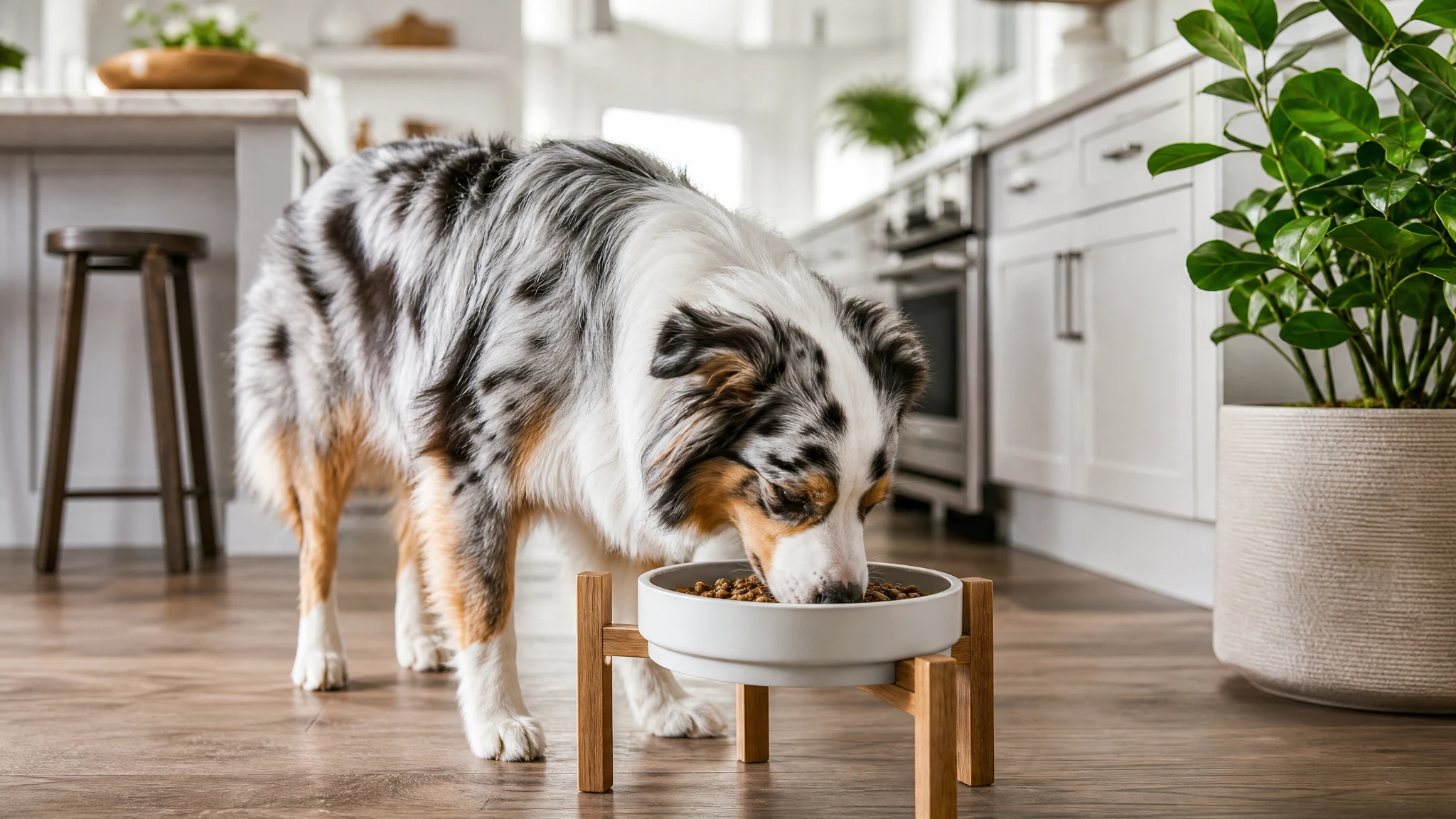
General nutrition information compiled from product labels and published sources, not veterinary advice. Your veterinarian is the right person to choose a diet for your dog, especially one with a health condition.
An Australian Shepherd on a ranch, an agility dog and a couch-and-walks pet can all weigh the same and still need different amounts of food. A printed feeding chart cannot know which dog yours is. It gives a starting point, and you do the adjusting.
This guide shows how to turn a label's feeding guide into a routine that fits your dog's real activity. If you still need the baseline numbers by age first, start with our Australian Shepherd feeding chart by age and come back here.
What you need
- The bag, can or tray of the food you actually feed, with its feeding guide and calorie statement.
- A kitchen scale. Royal Canin notes on its feeding guide that grams are the most accurate form of measurement, and cups are only given to the closest proximity.
- A standard measuring cup, if you measure by volume.
- A way to weigh your dog, such as a vet clinic scale or a bathroom scale (weigh yourself, then yourself holding the dog).
- A notebook or phone note for weight, amounts and body checks.
- Your veterinarian's contact details, for any dog with a health condition.
Why an Australian Shepherd chart needs adjusting
Wikipedia lists the adult Australian Shepherd at 35 to 70 lb (16 to 32 kg). Royal Canin's breed page describes males at about 50 to 65 lb and females at about 40 to 55 lb. That is a wide spread before activity even enters the picture.
No brand in the sources we reviewed publishes a feeding chart made only for this breed. Most charts are built by dog weight, and some add an activity level. Royal Canin's Medium Digestive Care chart, for example, lists daily amounts by weight (26 to 53 lb) and by low, medium or high activity. Hill's Science Diet pages simply say to adjust amounts as necessary to maintain optimal weight, and to ask your veterinarian if you are unsure.
One more caution: Royal Canin's Medium formulas are written for adult weights of 23 to 55 lb. A large male Aussie can sit above that range, so a chart may run out before your dog's weight does.
Step-by-step: adjusting the chart
Step 1: Find the starting amount on your food's label
Weigh your dog and find that weight on the feeding guide. Write down the daily amount, then the amount per meal. Treat the number as a starting point, as every label does.
If the guide has activity columns, pick the one that honestly matches the last month, not the one you hope for. A dog that gets two leash walks a day is low or medium. A dog that herds, runs trails or trains most days is closer to high.
Step 2: Note the calories in your food
Amounts only make sense next to calories. These per-cup figures come from the brands' own product pages:
| Food | Calories per cup (label) |
|---|---|
| Royal Canin Medium Digestive Care (dry) | 321 kcal ME |
| Royal Canin Medium Adult (dry) | 340 kcal ME |
| Hill's Science Diet Adult 6+ Large Breed Chicken Meal, Barley & Rice (dry) | 352 kcal |
| Hill's Science Diet Adult Large Breed Chicken & Barley (dry) | 365 kcal |
| Victor Chicken Meal & Brown Rice Formula (dry) | 372 kcal |
| Victor Hi-Pro Plus (dry) | 406 kcal |
| Freshpet Home Cooked Chicken Recipe (fresh) | 189 kcal ME |
We compared label data only. We did not run feeding trials or taste tests, so this table says nothing about how a dog does on any food.
The point is that one cup of a 406 kcal food is not the same as one cup of a 321 kcal food. Victor describes Hi-Pro Plus as a high-protein formula for active dogs, which also means it is calorie dense. If you switch foods, never carry the old cup amount over. Use the new label.
Step 3: Weigh the food, not just scoop it
Scoops vary with how you fill them and how big the kibble is. Weigh the daily amount in grams on a scale for a week and see how it compares with your usual scoop. Many owners find the scoop was off.
Step 4: Split the day into two meals
Most adult feeding guides work with one or two meals a day. Freshpet, for example, says its recipe can be fed as one meal daily or divided into two. For an active Aussie, two meals are a simple way to spread the food out. Keep a calm rest period around hard exercise, and ask your veterinarian about timing if your dog has had stomach trouble.
Step 5: Do a body check every two weeks
Weight alone can mislead in a coat as thick as an Aussie's. Check by hand:
- You should be able to feel the ribs under a thin layer of padding without pressing hard.
- Looking from above, there should be a visible waist behind the ribs.
- From the side, the belly should tuck up toward the back legs.
Record the date, the scale weight and what you felt.
Step 6: Change the amount in small steps
If your dog is getting leaner than you want during a busy season, raise the daily amount a little. If your dog is getting padded, lower it a little. Hold the new amount for two to four weeks before judging it. Small changes are easier to undo than big ones.
Ask your veterinarian how large a step suits your own dog. That answer depends on the dog, and we cannot set it from here.
Step 7: Re-check when the season or the job changes
Activity shifts with weather, show or sport seasons, injury rest and age. Go back to Step 1 whenever the routine changes for more than a couple of weeks. A dog on crate rest after an injury should not keep eating a trial-season amount.
Do not forget treats and extras
Training treats, chews and food toppers add calories that the chart does not count. If you train a lot, pull part of the daily amount from the bowl and use it as rewards. Pieces of the regular kibble work well for many dogs.
Supplements are a separate matter. Any product with a dose should be discussed with your veterinarian first. We do not give amounts for them here.
Life stage matters as much as activity
Royal Canin's breed page lists life stages for the Australian Shepherd as puppy from birth to 12 months, adult from 1 to 7 years, mature from 7 to 10 years and senior from 10 years. This comes from a manufacturer, not a vet or breed club, so treat the ages as a rough guide.
Puppies are a different case. Cornell University's Riney Canine Health Center advises a commercial large-breed puppy diet with an AAFCO growth adequacy statement and no extra calcium for growing dogs it discusses. Most Aussies finish under 70 lb, so a growth or all-life-stages food is the usual match, but check the AAFCO wording on the label. Victor Hi-Pro Plus, for instance, is labeled for all life stages except growth of large size dogs (70 lb or more as an adult). Do not guess with a growing puppy. Ask your veterinarian which food and amounts suit the puppy.
Common mistakes to avoid
- Picking the highest activity column by default. Many dogs that feel busy are only medium active.
- Keeping the same cups after a food change. Calories per cup differ by hundreds across brands, as the table shows.
- Judging by the scale only. Use your hands and eyes too.
- Changing amounts every few days. Give each change time before you decide.
- Forgetting treats. They count, even the small ones.
- Reading a medium-size chart as a perfect fit. A big Aussie may be past its weight range.
- Trying a high-calorie food just because the dog is active. A calorie-dense food may need a smaller scoop, not a bigger one.
When to call your veterinarian first
Confirm amounts with your vet if your dog has any health condition, is pregnant or nursing, is a growing puppy, is a senior, or is losing or gaining weight without a clear reason. A veterinarian decides what is right for an individual dog. Prescription diets are something only a veterinarian prescribes.
No food can be said to prevent or treat hip dysplasia, allergies, heart disease or bloat. The food sources we read do not claim it either. Diet is one part of a dog's care, and your vet's view of your dog outranks any chart.
Aussies can also carry MDR1 drug sensitivity, according to the OFA. That is not a food matter, but it affects medications and dewormers, so mention it to your vet at visits.
Expected results
With steady tracking, many owners find that their dog holds a stable, lean-looking shape through busy and quiet seasons. Energy and stool quality may be easier to read when the portions are consistent. Results vary with each dog's age, health, metabolism and daily life, and nothing here is a promise.
If your dog's weight keeps drifting after a month or two of careful changes, or you notice lethargy, vomiting, diarrhea or a change in appetite, stop adjusting and call your veterinarian.
Quick recap
- Find your dog's weight and activity on the label guide.
- Check the calories per cup of your actual food.
- Weigh the food in grams.
- Split the day into two meals.
- Check body shape every two weeks.
- Adjust in small steps and wait.
- Re-check when the routine changes.
For the age-based baseline, see our feeding chart by age.
Sources
- Royal Canin US breed library, Australian Shepherd
- Royal Canin Medium Adult Dry Dog Food
- Royal Canin Medium Digestive Care Dry Dog Food
- Hill's Science Diet Adult Large Breed Chicken & Barley Recipe
- Hill's Science Diet Adult 6+ Large Breed Chicken Meal, Barley & Rice Recipe
- Victor Hi-Pro Plus
- Victor Chicken Meal & Brown Rice Formula
- Freshpet Fresh From the Kitchen Home Cooked Chicken Recipe
- Cornell University Riney Canine Health Center, Panosteitis in dogs
- OFA, Multiple Drug Sensitivity
- Wikipedia, Australian Shepherd