Best Puppy Food for Australian Shepherd Puppies
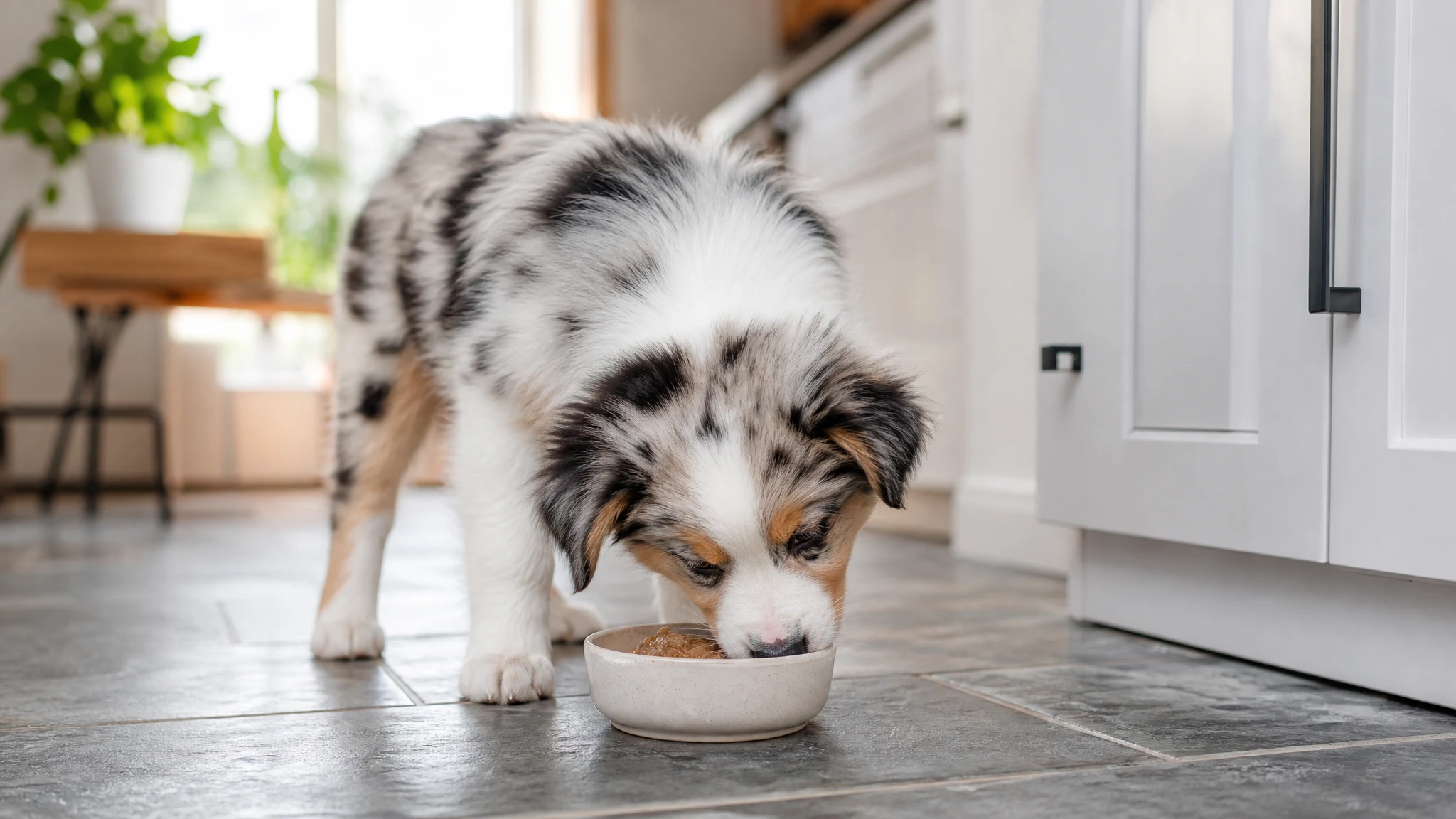
General nutrition information compiled from product labels and published sources, not veterinary advice. Your veterinarian is the right person to choose a diet for your dog, especially one with a health condition.
Choosing the best puppy food for Australian Shepherds comes down to reading labels, not packaging. An Aussie puppy grows fast, burns plenty of energy, and ends up a medium dog. The right bag matches that growth pattern and says so in plain words on the label.
This guide explains what to check on any Australian Shepherd puppy food, then walks through the formulas whose label data shows they cover growth. It also covers red flags, feeding rhythm, when to move to adult food, and where to buy.
How we compared these foods
We compared label data published on each brand's own product page: the AAFCO statement, the first five ingredients, the guaranteed analysis, and calories per cup. We did not run feeding trials or taste tests, and we do not claim any dog ate these foods for us.
We list no prices, ratings or reviews. Prices change by store and bag size, so check the brand or your store. Every figure below belongs to the brand that published it.
What an Australian Shepherd puppy needs from a food
Wikipedia lists the adult Australian Shepherd at 35 to 70 lb (16 to 32 kg). The Royal Canin US breed library describes males at about 50 to 65 lb and females at about 40 to 55 lb. That makes the breed medium in size, though no source states this category directly, so we are inferring it from weight.
Weight matters because puppy foods are written for size groups. A few Aussies, mostly big males, sit near the top of that range.
The Cornell University Riney Canine Health Center advises a commercial large-breed puppy diet with an AAFCO growth (or growth and lactation) adequacy statement and no extra calcium. Cornell makes that point in its page on panosteitis, a bone condition in growing dogs. Most Aussies finish under 70 lb, so a general growth or all-life-stages food is the usual match. The large-size wording matters mainly for puppies who will end up at the heavy end of the breed.
A veterinarian decides what is right for an individual puppy. No food on this page is a treatment for anything, and none replaces that advice.
What to look for: quality indicators
1. An AAFCO growth statement
This is the first check. Look for wording like "formulated to meet the nutritional levels established by the AAFCO Dog Food Nutrient Profiles for growth" or "for all life stages." A food that says "for maintenance" is built for adults and is not a puppy food, even if the bag shows a puppy on the front.
2. The large-size growth wording
Some labels carry one of two phrases. "Including growth of large size dogs (70 lb. or more as an adult)" means the food meets the rule for large-breed puppies. "Except for growth of large size dogs (70 lb. or more as an adult)" means it does not. We could not confirm the calcium limit behind this rule from a source we opened, so we do not state it. We simply report which phrase each label uses.
3. Named animal ingredients first
Ingredient lists run from heaviest to lightest. A named protein such as chicken, chicken meal or beef meal near the top is easy to read. Vague wording is harder to judge. Meals are not a flaw. They are concentrated protein with the water removed.
4. A guaranteed analysis you can compare
Crude protein and fat minimums, and fiber maximums, are required numbers on a dry food label. Compare them across products, but keep in mind that wet and fresh foods contain much more water, so their percentages look smaller without being worse.
5. Calories per cup
Calories decide how much you scoop. Two foods with the same protein can differ a lot in energy, so the feeding guide matters more than the cup size.
Key features to compare
These are the puppy-suitable formulas whose label data we reviewed. All figures come from each brand's own product page.
| Food | Form | AAFCO statement | Protein | Fat | Calories |
|---|---|---|---|---|---|
| Royal Canin Medium Puppy | Dry | Growth | 30.0% min | 18.4% min | 410 kcal ME per cup |
| Victor Hi-Pro Plus | Dry | All life stages, except growth of large size dogs | 30.0% min | 20.0% min | 406 kcal per cup |
| Victor Chicken Meal & Brown Rice | Dry | All life stages | 24.0% min | 12.0% min | 372 kcal per cup |
| Nom Nom Chicken Cuisine | Fresh, gently cooked | All life stages, including growth of large size dogs | 6.5% min | 4.5% min | 244 kcal per cup |
| JustFoodForDogs Pantry Fresh Chicken & White Rice | Fresh, shelf-stable pouch | All life stages, including growth of large size dogs | 6.5% min | 2.5% min | 31 kcal ME per oz |
The two fresh foods are far lower in protein and fat on paper because of moisture. Do not compare them to the dry foods line by line. Compare the dry foods with each other, and the fresh foods with each other.
None of the product pages we opened stated kibble size, so check with the brand if your puppy is small or a fast eater.
Top picks by type of food
We cannot rank by price, because we have no verified prices. Instead, here are the options grouped by form, so you can decide on budget and routine with current prices in front of you.
Dry food built for puppies: Royal Canin Medium Puppy
The Royal Canin Medium Puppy page says the food is for puppies up to 12 months, with an adult weight of 23 to 55 lb. Its AAFCO statement covers growth. The first five ingredients are chicken by-product meal, chicken fat, brewers rice, corn and wheat. It is not grain-free.
The guaranteed analysis shows 30.0% protein minimum, 18.4% fat minimum and 4.0% fiber maximum, at 410 kcal ME per cup (as fed, calculated). The feeding guide lists amounts by puppy age in months and expected adult weight.
One caution. The 23 to 55 lb range sits below the top of the Aussie range. If your puppy's parents are large males near 65 lb, ask the breeder and your veterinarian whether this size group fits. We could not confirm from the page we opened whether the statement also covers large-size growth, so read the full statement on the bag.
Dry all-life-stages food: Victor
Victor sells two dry foods that carry an all-life-stages statement, which includes growth.
Victor Hi-Pro Plus is a high-protein formula for active dogs. Its first five ingredients are beef meal, grain sorghum, chicken fat, whole grain millet and dried blood meal. The label reads "All Life Stages, except for growth of large size dogs (70 lb. or more as an adult)." So it is not a large-breed puppy food. Since an Aussie normally stays under 70 lb, that exception usually does not apply, but a puppy headed for the very top of the range deserves a second look. At 406 kcal per cup it is calorie-dense, so measure carefully.
Victor Chicken Meal & Brown Rice Formula is described for normal activity levels. First five ingredients: chicken meal, grain sorghum, peas, whole grain millet and whole grain brown rice. Its statement reads "for All Life Stages" with no large-size exception in the wording we saw. Check the bag for the full text. Guaranteed analysis is 24.0% protein minimum, 12.0% fat minimum and 4.0% fiber maximum, at 372 kcal per cup.
Victor's feeding guide on both pages gives an extra half cup for every 20 lb over 100 lb. That is for much larger dogs than an Aussie, so use the lower weight rows for your puppy.
Fresh food: Nom Nom and JustFoodForDogs
Nom Nom Chicken Cuisine states it meets the AAFCO profiles for all life stages, including growth of large size dogs. The first five ingredients are chicken, sweet potatoes, squash, spinach and dicalcium phosphate. It lists 6.5% protein minimum, 4.5% fat minimum and 244 kcal per cup. Nom Nom describes its feeding guide as a guide that may vary, for a full Nom Nom diet.
JustFoodForDogs Pantry Fresh Chicken & White Rice carries the same "including growth of large size dogs" wording. It starts with chicken breast, chicken thighs, chicken liver, long-grain white rice and kale. The 12.5 oz pouch provides 387.5 kcal ME, or 31 kcal ME per oz. The page gives no per-cup figure.
Fresh foods are usually the costlier route per day for a growing dog, but we have no verified prices, so confirm current cost with the brand. Many owners use them as a topper or a partial feed. The brand pages are where to check whether that suits their formulas.
Foods we left out
Some products on the same brand sites are not puppy foods. The Royal Canin Medium Adult formulas, the Hill's Science Diet large-breed adult recipes, and the Freshpet Home Cooked Chicken Recipe all carry adult maintenance statements. They are fine choices later, but they are not formulated for growth.
We also found no breed-specific Australian Shepherd dry formula sold in the US. Foods marketed to "herding dogs" or similar are worth checking by the same label test, not by the breed name on the front.
Red flags to avoid
- No AAFCO statement at all. Without one, you cannot tell whether the food is complete for growth.
- "For maintenance" only. That is an adult food, however cute the puppy on the bag.
- Added calcium supplements. Cornell advises against extra calcium for growing puppies. A complete growth food already has what is needed.
- Health promises. A bag that claims to prevent or cure hip problems, allergies or heart disease is making a medical claim that food labels should not make. Diet questions belong with your veterinarian.
- Grain-free as a selling point. The FDA's investigation into diets and canine dilated cardiomyopathy had its latest update on December 23, 2022. The agency said it would not issue more public updates until there is meaningful new scientific information, and it does not treat report numbers as proof of cause. Do not choose or avoid a food on that headline alone. Ask your veterinarian.
- Treating the feeding guide as a rule. It is a starting point. Brands say as much, and Royal Canin notes that grams are more accurate than cups.
- Switching foods abruptly. A sudden change can upset a young stomach. Mix the old and new food over several days.
Feeding rhythm and amounts
Young puppies do best on several small meals spread through the day rather than one or two big ones. As the puppy grows, owners usually move to fewer, larger meals. Your veterinarian can tell you when that suits your dog.
For amounts, use the label's feeding guide as a starting point. The Royal Canin Medium Puppy guide works by age in months and adult target weight. Other brands use current weight. Weigh your puppy regularly, and adjust with your veterinarian's help if the puppy is getting too thin or too round.
Treats and training rewards count toward the day's food. Aussies are eager to work for food, so it is easy to overshoot.
When to switch to adult food
Royal Canin's breed library gives life stages for the Australian Shepherd: puppy from birth to 12 months, adult from 1 to 7 years, mature from 7 to 10 years, and senior from 10 years. That is a manufacturer's guide, not a veterinary or breed club ruling, so treat it as a rough marker.
Royal Canin Medium Puppy is labeled for puppies up to 12 months. Many Aussies finish growing around that time, but some take longer. Ask your veterinarian before you change, and make the swap gradually.
If you feed an all-life-stages food, you may not need to change formulas at all. Just reduce the portion as growth slows and your puppy's body condition allows.
Where to buy
Start with the brand's own page, linked above, for the current label, statement and any list of stockists. Pet supply stores and your veterinarian's clinic also carry some of these foods. Fresh brands often sell direct from their own sites.
Whichever route you use, read the bag when it arrives. Check the AAFCO statement, the date, and that the formula name matches the page you studied. Formulas change, and the bag in your hands is the final word.
Quick checklist before you buy
- Does the label carry a growth or all-life-stages AAFCO statement?
- Does it include or exclude growth of large size dogs, and does that fit your puppy's expected size?
- Are the first ingredients named and easy to understand?
- Do you know the calories per cup and the label's feeding guide?
- Has your veterinarian signed off on the plan?
The best food for an Australian Shepherd puppy is one that meets the growth standard, suits your puppy's likely adult size, and that your puppy eats well and thrives on. Use this guide to narrow the field, and let your veterinarian make the final call.
Sources
- Cornell University Riney Canine Health Center, Panosteitis in dogs
- Royal Canin US breed library, Australian Shepherd
- Wikipedia, Australian Shepherd
- FDA CVM, Investigation into Potential Link between Certain Diets and Canine DCM
- Royal Canin, Medium Puppy Dry Dog Food
- Victor, Hi-Pro Plus
- Victor, Chicken Meal & Brown Rice Formula
- Nom Nom, Chicken Cuisine
- JustFoodForDogs, Pantry Fresh Chicken & White Rice Recipe